

An AI draft arrives in the CMS with a title, description and cover image. Then an editor follows a policy citation: the page exists, but it does not support the claim. A product specification has a source too, except it describes an older model. The prose reads smoothly. Verification takes much longer.
This is an illustrative scenario, and a useful failure mode to plan for. When AI accelerates drafting, much of the work can move into verification. A dependable publishing process needs separate, checkable deliverables for each stage.
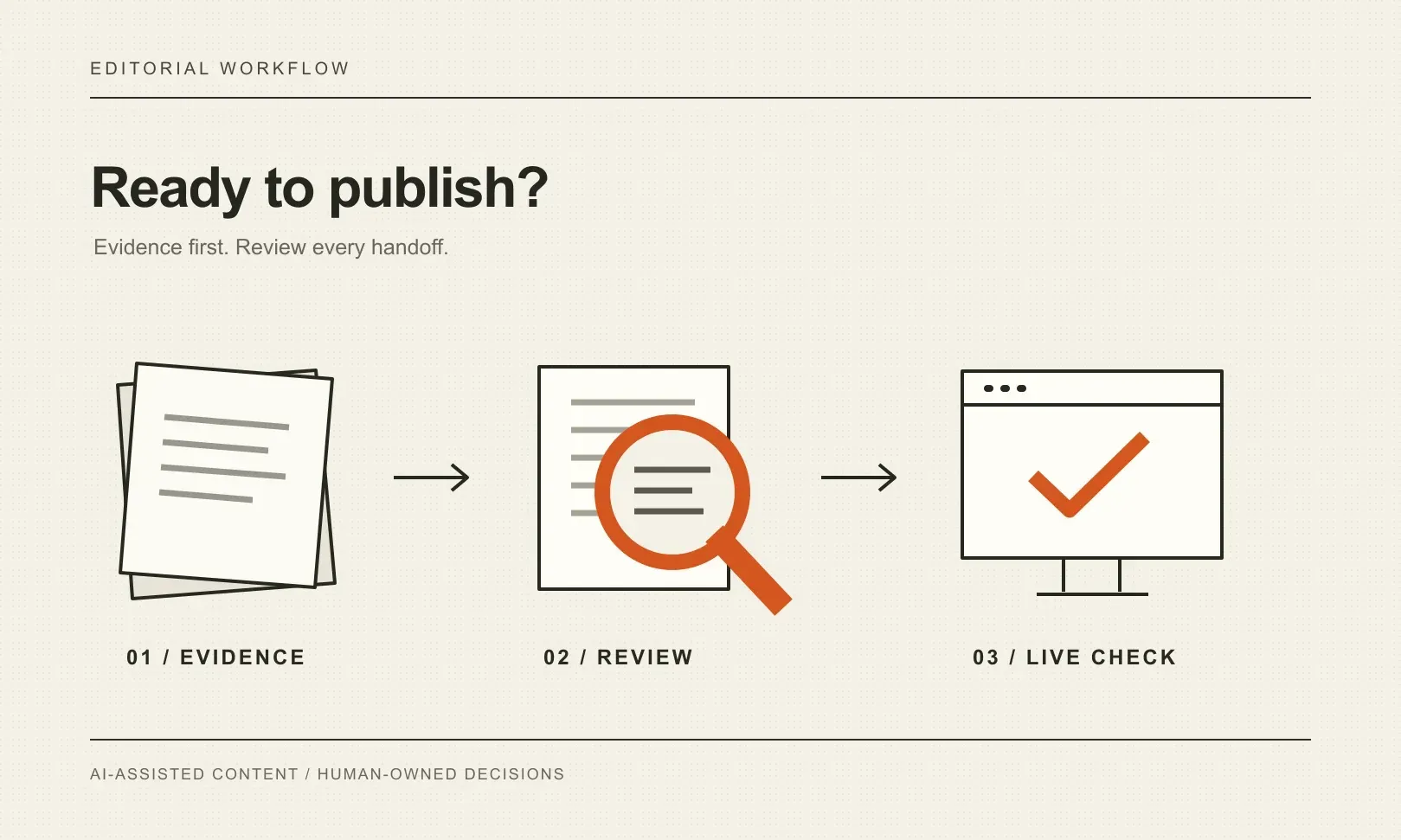
Our recommendation is to build an evidence sheet before expanding the draft, then review facts, images and the published page separately. For a new product with limited documentation, or a topic requiring specialist knowledge, obtain confirmation from the product owner or a qualified specialist first. Missing evidence should remain an open question.
Narrow the assignment to one answer a reader needs
“Write an article about AI SEO” leaves too much room. The result can easily become a definition, a list of benefits, a trend section and a conclusion, without helping anyone decide what to do next.
A more useful assignment is: “Explain which evidence a three-person content team should retain as an AI-assisted article moves from research to publication.” That sentence defines the audience, the problem and the deliverable. It leaves room to explain review methods without trying to cover keyword research, site architecture and paid advertising at the same time.
Before drafting, check whether the site already answers the same question. If an existing article covers most of it, consider updating that page. Create a new URL when the new piece has a distinct job. Our guide to SEO content strategy and topic maps explains how to divide those jobs.
Write an acceptance criterion too: “After reading, an editor can use one checklist to decide whether a draft is ready.” This helps prevent scope drift. Keywords still belong naturally in the title, description and passages that answer the question.
Build the evidence sheet before polishing the prose
Google’s guidance on generative AI content recognizes AI’s usefulness for research and organizing original content, while emphasizing accuracy, quality and relevance. Its spam policies address large-scale, low-value content created primarily to manipulate rankings, regardless of how that content is produced.
Editorial review therefore needs to reach the individual verifiable claim. Statements such as “Google requires,” “the average improvement is” or “the platform has launched” need support from a specific passage. Linking to an official homepage cannot substantiate every claim in the paragraph above it.
Use the following as a minimal evidence sheet. If the final column cannot be answered, hold the claim out of the draft.
| Proposed content | Evidence to retain | Decision before inclusion |
|---|---|---|
| Platform rules and features | Official page, relevant passage and date checked | Do the region, account type and rollout scope match? |
| Product specifications and performance figures | Product documentation, original report or confirmed project record | Do the model, units, sample and time window match? |
| Team experience and recommendations | Actual work records or an explicit chain of reasoning | Can the conditions supporting the recommendation be stated? |
| Worked examples | Assumptions, calculation and result | Is the example clearly distinguished from actual performance? |
For example, “every article needs at least 2,000 words to rank” should not become a review requirement. Google’s people-first content guidance says it has no preferred word count. A team may set an editorial length based on the complexity of the question, while recognizing that as its own production choice.
When sources disagree, preserve their conditions and limits. If the issue remains unresolved, narrow the claim, remove it or send it for confirmation. Asking AI to generate a more convincing citation does not close the evidence gap.
Give AI clear work and assign responsibility for decisions
Once evidence is organized, AI’s useful tasks become easier to define: sorting material, proposing an outline, identifying missing explanations, comparing headlines, shortening repetitive passages and preparing a translation from the approved source text.
A practical instruction is: “Use only facts supported by the attached evidence sheet. Explain why each review step matters to a content manager. Mark unsupported points for verification. Do not invent figures or cases. Distinguish official rules from editorial recommendations.” This constrains the source material, but verification is still required.
The product owner checks models and features. The editor checks reasoning and language. The publisher checks pages and links. One person can cover several roles in a small team, provided the passes remain separate: first facts, then comprehension, then publication. Polishing while checking can make readable prose feel verified before it is.
An additional AI review can help find contradictions, inconsistent terminology and missing qualifications. It can also repeat the same error. For a material figure or platform rule, the decisive check is opening the source and reading the relevant passage.
Ask what the reader can actually do with the article
Accurate content can still be unhelpful. A draft may restate public documentation without explaining how a reader should choose in a particular situation.
Take one section and remove the brand name. If it could fit any industry or website unchanged, look for a missing object, condition or reason. “Keep improving content quality” could become “Check the source of every figure before publication; if the product model differs, correct the specification before continuing with layout.” The second version gives the reader a starting point.
Check whether the article delivers what its headline promises. A checklist needs actionable checks. A comparison needs dimensions and tradeoffs. Our article on title tags, meta descriptions and H1s explains the different jobs those elements perform.
Reviewer attribution needs the same care. A template containing an “expert reviewed” field is no reason to insert a colleague’s name automatically. Authorship, citations and case ownership are factual statements too.
Choose an image’s job before choosing its appearance
A generic robot image adds little to an article about editorial review. An evidence-to-publication diagram, an annotated interface screenshot or an illustration of verification can serve the subject more directly. Each has a different purpose; a single article does not need all three.
Start with one question: what will this image make easier to understand? For a procedure, a current screenshot may help, with account details, secrets and customer information removed. For a method, a diagram can explain relationships. For a cover, the main subject should relate to the article’s central problem.
Then check the source and permitted use. Finding an image in search does not establish permission to use it, and existing assets still need to fit the project’s usage scope. AI-generated scenes should be presented as illustrations, without implying that they depict real customers, events or product photography.
Google’s image guidance recommends clear, relevant images, descriptive filenames and useful alternative text. An editor should also inspect the mobile preview: is the main subject intact after cropping, is any small text legible, and is the image compressed appropriately? Alt text should describe useful visual information without repeating keywords unnecessarily.
Finish the review with a release checklist
The following is our proposed editorial checklist. It organizes production work; it is not a Google ranking score. Return an item to its owner when a check fails.
| Review stage | Ready to proceed when | Common reason to return |
|---|---|---|
| Topic | It answers a clear question and has a distinct role on the site | A new title masks substantially repeated content |
| Facts | Sources support key claims, figures and scope | A citation exists but does not support the conclusion |
| Content | A reader can act, and recommendations state their conditions | Vague advice, invented cases or exaggerated results |
| Images | Relevance, permitted use, cropping and alt text have been checked | Unclear provenance, an outdated interface or illegible mobile text |
| Page | Title and body match, links and images work, and indexing settings reflect intent | A 404, stale content, an incorrect canonical or accidental noindex |
Consider a worked example: a batch contains eight drafts. Two lack essential evidence and one has an image of uncertain origin. Five are currently ready. The other three should return to research or image selection, rather than being marked complete and left for the publisher to resolve. These numbers demonstrate workload tracking and do not describe a client result.
The record can stay simple. Keep the article version, unresolved issues, responsible person, verification date and live URL. The next editor should be able to see what has already been checked.
Check the real URL after publishing
A successful save confirms that the CMS stored the content. On a static site, saving, building the site and updating the public page may be separate steps. Verify the live result independently.
Open the production URL in a signed-out browser. Check the body, date, images, internal links and mobile layout. Confirm that the canonical points to the intended URL, noindex has not been applied accidentally, and the article appears in the listing and sitemap. For multilingual content, verify that language switching reaches the corresponding version and that the English page has not fallen back to Chinese.
When checking Google’s access, remember that the URL Inspection tool initially reports on the indexed version. “Test live URL” examines current accessibility. It can help diagnose issues, but does not predict rankings or guarantee indexing. Google’s recrawl guidance also makes clear that a request does not guarantee immediate, or eventual, inclusion in search results.
Completion should leave a checkable record: the reader’s question is answered, material claims have evidence, images serve a purpose and the live page works. Before increasing output, check whether the team can still complete those steps. If review is already becoming a queue, address that constraint first.
Related reading
- Content strategy in the AI era: topical authority, quality and updates
- SEO content strategy and topic maps: from user journey to publishing plan
- On-page SEO: titles, page structure and internal links
Editorial note: AI assisted with research organization and drafting. Key platform rules were checked against the official sources listed. The workflow and checklists are String’s editorial recommendations. Illustrative scenarios and calculations do not describe real clients.