

Generative tools have pushed the cost of producing content close to zero, and plenty of global sites now watch their content libraries grow while their reports get more awkward by the quarter. New pages keep shipping every week; the clicks still come from the same few old faces. Meanwhile, pages that already sit near the top of search results sit untouched for months. In the AI era, an SEO content strategy shifts its focus from output volume to asset management.
The sequence in this series is deliberate. Choosing which pages to build belongs to Keyword Research and Search Intent. Making each page land belongs to On-Page SEO. This piece fills the layer in between, how content assets get managed over time. The parent guide, What Is SEO?, already covers how AI writing and AI search relate; one sentence carries it forward, AI-assisted creation is fine, and the real red line is mass-producing content with no value.
Topical authority before one-off hits
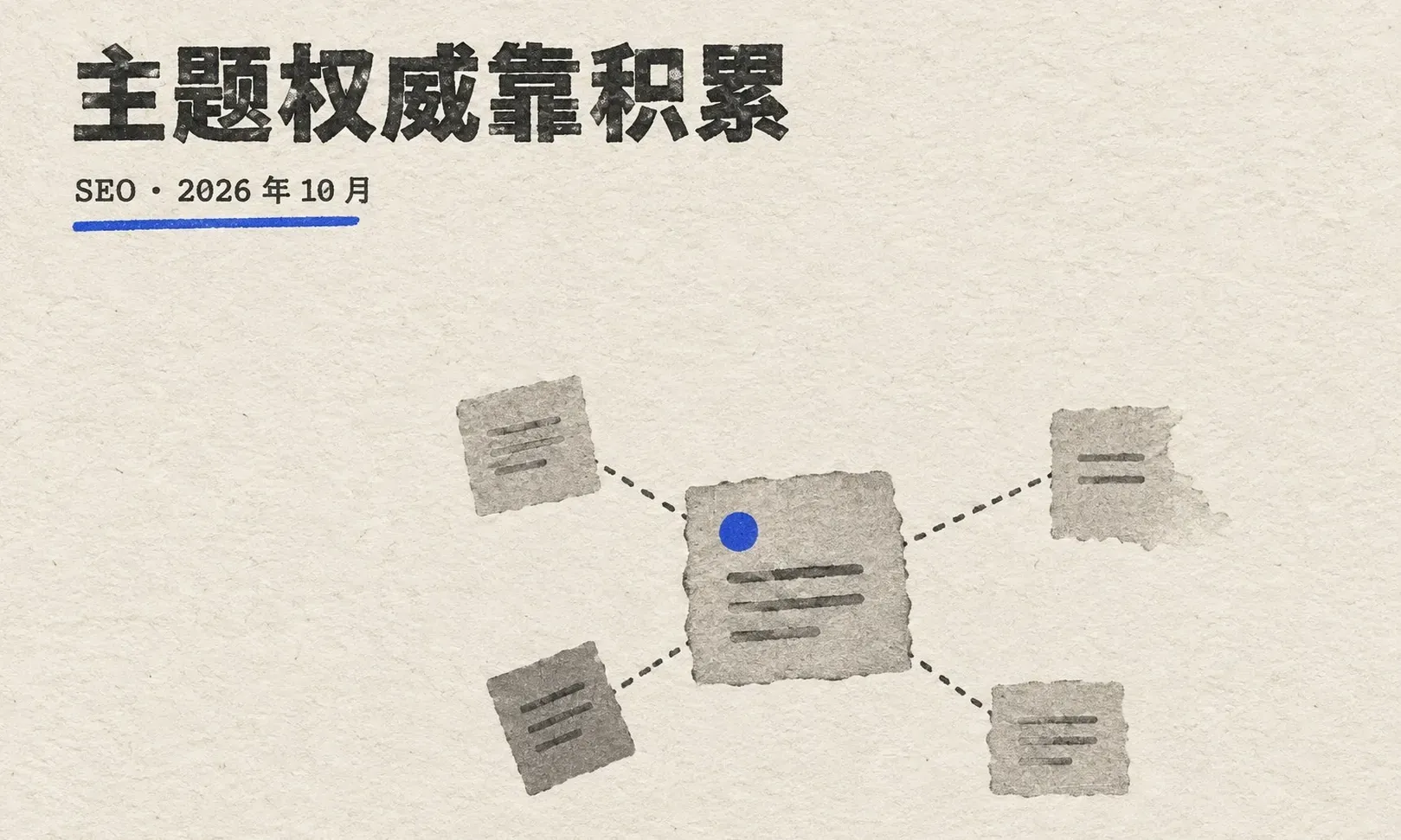
Viral hits are probability; topical authority is accumulation. Search systems increasingly read a site the way a specialist reads a field, and a set of interlinked pages that back each other up is more durable than a single lucky ranking, especially when algorithms shift.
The build path is simple. Pick one core topic, plan a cluster of pages around it, give each page one sub-intent, and connect the pages with internal links until they form a web. The counter-pattern is chasing trends with scattered posts, three pages competing for the same terms, and nothing on the site cross-referencing anything else.
Choosing the main axis has a practical starting point, the overlap of business and demand. The ten questions customers ask most, the three dimensions sales compares before closing a deal, usually hide the spine of the cluster. Draw the axis first, then lay out pages; doing it the other way around tends to pile up unrelated pages.
A quick self-check starts with searching your own site for the topic. If the top results form a complete chain of evidence, the cluster stands. If a single orphan page shows up, or the pages contradict each other, the assets have not become a network yet.
Official guidance is worth borrowing for calibration. Google's ranking systems prioritize content created for people, and weigh experience, expertise, authoritativeness, and trustworthiness, with trust the most important. This standard is not a bonus point for individual posts; it settles the account for the whole topic asset.
Quality, the differentiator in the AI era
Before discussing quality, set the official position in place. Google's blog says ranking systems reward high-quality content however it is produced, and using automation, including AI, to generate content primarily to manipulate rankings violates spam policies. Put into practice, that means AI generation itself is fine; the problems live in purpose and in added value.
Turn the sentence into a checklist and quality gets measurable. Original information, reporting, research, or analysis, present or not. Is the topic covered substantially and completely. First-hand experience or evidence, cases, data, raw materials, present or not. Authorship and accountability, who stands behind it. Are sources verifiable, are citations traceable. If two of the five questions have no answer, the piece should not go live.
One more official self-assessment frame, who, how, and why. Who made it, and can readers perceive the author's background. How it was made, is the process and basis disclosed. Why it was made, to help readers, or to stuff keywords.
AI writing or human writing, a division of labor
In practice this question already has an answer; picking sides is pointless, dividing the work is not. Put AI where it is strong, on research assembly, first drafts, structural variants, translation drafts, and bulk checks. Keep judgment with people. That means topic calls, first-hand evidence, fact verification, opinions and conclusions, final review and the byline.
Two red lines hold the process together. First, mass-generating pages whose primary purpose is to manipulate rankings falls inside spam policy enforcement; do not go near it. Second, facts that have not been verified do not ship; AI output is material awaiting review, not fact.
One note for advanced teams. The production of AI-related content is moving into regulatory view. Disclosure and labeling requirements for generated content are landing across platforms, and content compliance is becoming a standing pre-publish check alongside quality. That topic gets its own piece later.
Update or publish new, a rule backed by data
Start with two real signals from the latest weekly review (2026-W40). An overseas marketing page on the English site (/en/insights/overseas-marketing-of-sex-toys/) sits at position 6.7 with 245 impressions and zero clicks. A Google Ads and GA updates page (/insights/google-ads-ga-ai-agentic-updates/) sits at position 5.9, also with zero clicks. The positions are fine; the clicks are absent, which says the titles and snippets are not catching the demand. The move for pages like these is an update. The common alternative, leaving them alone and writing a brand-new post for the same term, wastes the position they already hold.
That produces a rule of thumb by position. Pages at positions 1 to 5 get title and snippet tuning to convert impressions into clicks. Pages between 6 and 20 get substantive updates first, added content, refreshed data, new internal links, rewritten titles and snippets; reaching this band means the page has already proven relevance, and updates deliver the best return. Pages beyond position 20 face a different question, whether a stronger page already covers the topic; if so, consolidate or rebuild instead of feeding more content into the gap.
The update checklist can be fixed. Add new evidence and data; correct outdated information; link the page into its topic cluster; align title and snippet with search intent; then enter an observation window measured in weeks.
One bottom line deserves its own sentence. A pseudo-update that only changes the publish date adds no substance, wastes a crawl, and spends the team's trust.
The content lifecycle, stringing decisions into a process
Pulling the sections together, the full lifecycle of a content asset runs through five stages, planning, production, publishing, observation, and disposition. Disposition has three moves, update, consolidate, retire, and the criteria are the position bands and coverage checks from the previous section.
The series will break this outline down next. The topic map and publishing plan answer what to write first, what comes after, and how the pages support each other; the AI-assisted workflow and human review answer where AI fits in each stage and what people check; E-E-A-T and the content lifecycle will give the full decision tree for updating, consolidating, and pruning. Those pieces are coming.
Common pitfalls
Chasing one-off hits without building a cluster. Hits are not repeatable; clusters compound. Betting on the next post beats nothing; completing the topic you already own beats both.
Flooding the site with AI bulk content. Homogeneous pages dilute the topic and touch spam policy; the writing time saved gets paid back in site-wide trust.
Publishing new posts without ever looking back. Pages in positions 6 to 20 are assets already on the books; leaving them alone keeps them at zero clicks.
Turning updates into date changes. Readers and systems both notice a change with no substance behind it.
Related Reading
- What Is SEO? A Practical Guide from Search Fundamentals to Business Implementation, the root of the series, with the full argument on AI writing and AI search.
- Keyword Research and Search Intent: From Demand to a Working Keyword Set, pick the right topics first, then manage how the content ages.
- On-Page SEO: Titles, Page Structure, and Internal Links, where asset-level planning lands as page-level execution.