
When people first hear about SEO, they often reduce it to three things: finding keywords, writing articles, and getting onto the first page of Google.
That is not entirely wrong, but it captures only the most superficial layer. You can choose the right keywords while the page itself is never crawled. An article may rank but attract people who will never buy. Traffic may rise while inquiries remain flat. A page that ranks well today may fall after its content becomes outdated or competitors update theirs.
The real purpose of SEO is not to trick an algorithm into promoting a page. It is to help search systems discover, understand, and trust your content so that people with genuine needs can find it at the right moment and take the next step that matters to your business.
For management purposes, this can be condensed into a simple formula:
Practical SEO results = Discoverable × Understandable × Aligned with intent × Trustworthy × Able to convert
This is not Google's ranking formula. It is a business diagnostic framework. The factors are multiplied because if any one of them is close to zero, the end result will be poor. Great content cannot earn visibility if a noindex directive blocks it. A high-ranking page will not earn clicks if it fails to answer the query. Large amounts of traffic will not generate revenue if the product or conversion path is flawed.
What Is SEO?
SEO stands for Search Engine Optimization. Google's explanation of SEO is straightforward: it helps search engines understand your content and helps users find your site through search and decide whether they should visit it.
SEO therefore serves two audiences at the same time:
- Search systems: Ensure that pages can be discovered, crawled, rendered, indexed, and correctly understood.
- Real users: Use the right page to satisfy search intent, establish trust, and help people complete an inquiry, registration, purchase, or another goal without friction.
Rankings are an intermediate variable, not the destination. For a business, SEO should ultimately produce qualified traffic, branded demand, inquiries, orders, pipeline value, or revenue, rather than a screenshot showing how many keywords have reached the top ten.
The discussion below primarily uses Google web search as an example because Google publishes relatively comprehensive technical documentation. Bing and other search systems share some of the same fundamentals for discovery, indexing, and serving results, but their specific controls, reports, and AI features should be reviewed separately.
What SEO Is Not
- SEO is not repeating the same keyword throughout the body copy.
- SEO is not mass-publishing several AI-generated articles every week.
- SEO is not installing a plugin and turning every indicator green.
- SEO is not buying large numbers of backlinks or a supposed "website authority" score.
- SEO is not a guarantee of indexing, a number-one ranking, or a citation in an AI-generated answer.
- SEO is not truly free. You do not pay per click, but content, engineering, tools, distribution, and ongoing maintenance all cost money.
How SEO Differs from SEM, Content Marketing, and GEO
These four concepts are often conflated, but they solve different problems.
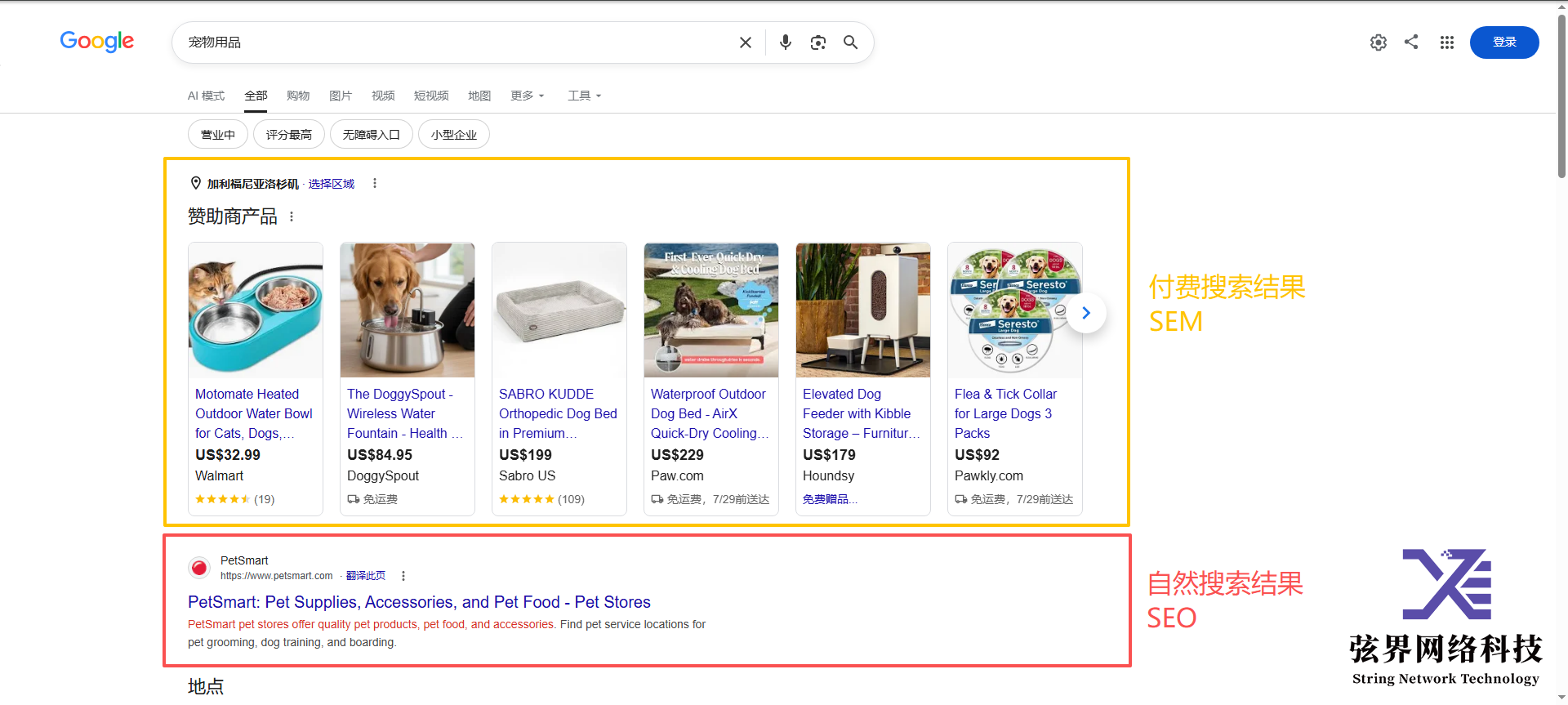
| Method | Primary objective | How visibility is gained | Speed and control | After investment stops |
|---|---|---|---|---|
| SEO | Capture organic search demand | Technical improvements, content, connections between pages and sites, and authority signals | Usually slower to produce results; rankings cannot be purchased directly | Strong pages may continue to attract traffic but still require maintenance |
| Paid search / SEM | Buy search visibility quickly | Auction-based ads, budgets, and audience settings | Fast to launch and highly controllable | Ads usually stop when the budget stops |
| Content marketing | Educate the market, build trust, and drive conversion | Articles, videos, reports, case studies, email, and more | Depends on the distribution channel | Content assets can continue to be repurposed |
| GEO / AI search optimization | Increase opportunities for brand visibility and citations in generative answers | Clear facts, verifiable evidence, consistent entity information, and third-party signals | Platforms change quickly, and visibility is less controllable | Depends on content accessibility, freshness, and external signals |
In practice, these methods often work together. Use ads to validate keywords and landing pages, SEO to capture long-term demand, and content to build trust, then make the same body of reliable information useful to both traditional and AI search. When the business has a firm short-term performance target, advertising is usually more appropriate than waiting for organic rankings. Relying entirely on advertising over the long term, however, leaves acquisition costs continually exposed to auction pressure.
How Search Engines Work: Meet the Search Requirements Before Pursuing Rankings
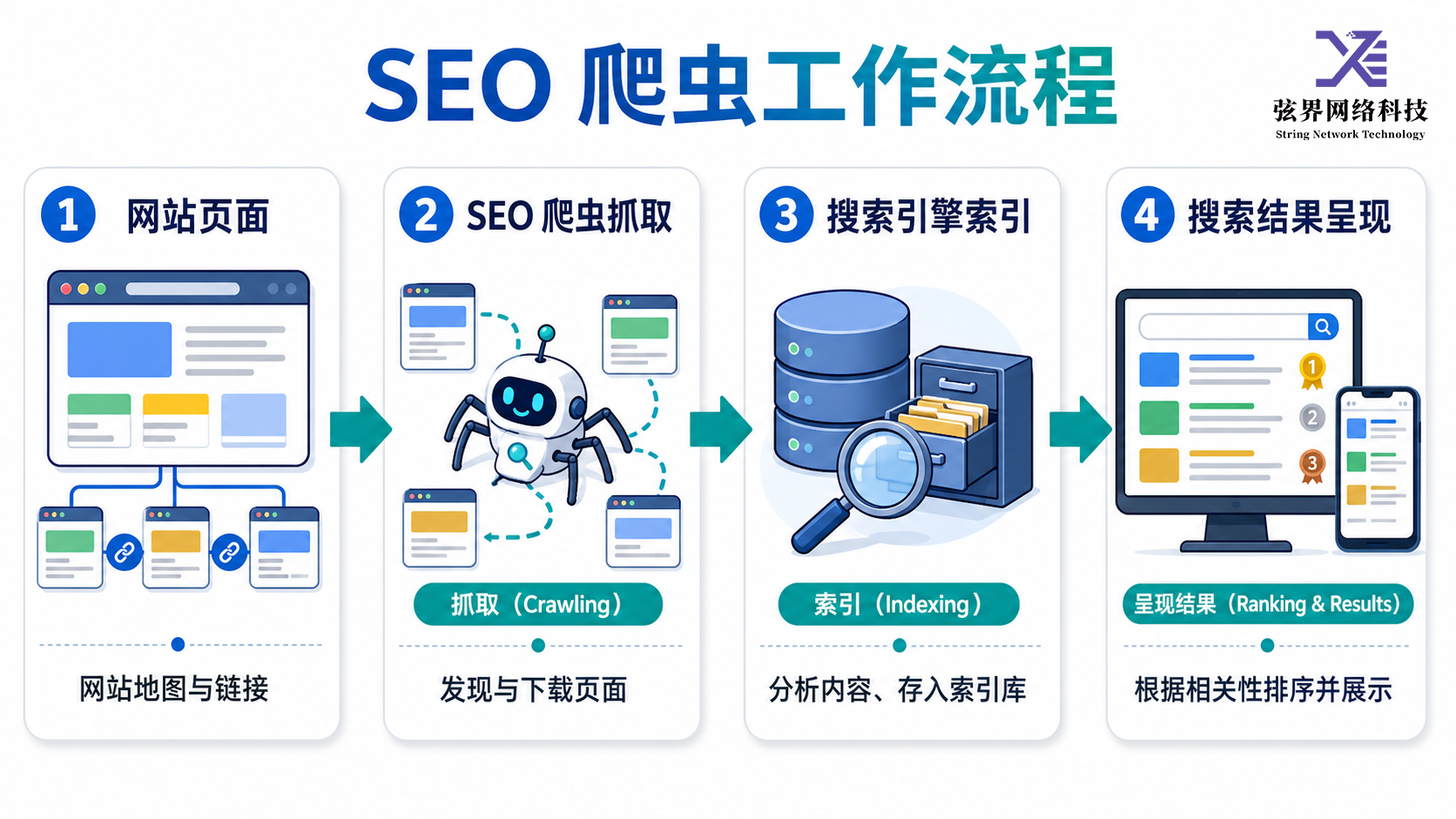
Google describes search in three stages: crawling, indexing, and serving search results. Understanding these stages prevents teams from misdiagnosing every problem as "poor rankings."
1. Crawling: Can the Search Engine Find and Access the Page?
Search engines use crawlers to discover new URLs by following links between pages, and they also consult sitemaps. After discovering a URL, a crawler attempts to request the page, retrieve its resources, and render its content.
Common reasons this process fails include:
- The page has no crawlable internal links and has become an "orphan page."
robots.txtblocks crawling.- The page requires users to log in.
- The server frequently times out or returns 5xx errors.
- Important content depends on problematic JavaScript and remains invisible after rendering.
- Navigation and filtering systems generate a near-infinite number of duplicate URLs.
A sitemap is only a discovery signal. It is not an application for indexing, much less a way to accelerate rankings. Whether a page is easy to discover depends first on the clarity of the site's information architecture and internal linking.
2. Indexing: Can the Search Engine Understand and Store the Page?
After crawling, search systems analyze the main content, titles, images, videos, links, canonical URLs, and other information to determine what the page is about, assess its quality, and decide which URL version should be treated as canonical.
Three points are often confused here:
- Crawling does not equal indexing. A page may be accessible but still remain unindexed because its content is duplicate or insufficient, its canonical URL points elsewhere, or it carries a
noindexdirective. robots.txtprimarily controls crawling; it is not a reliable tool for removing a page from the index. To keep a page out of the index, use an appropriatenoindexdirective, access controls, or password protection, and make sure the search engine can read the relevant directive.- A canonical declaration is a signal, not an absolute command. It helps search engines select a canonical version and consolidate signals among duplicate or near-duplicate pages, but the search system may still choose a different version.
Google's published minimum technical requirements are straightforward: Googlebot must not be blocked, the page must return an HTTP 200 status code, and the page must contain indexable content. Meeting these requirements only makes a page eligible; it does not guarantee indexing.
3. Serving Search Results: Why Should Your Page Appear for This Query?
When a user searches, the system looks through its index for relevant, useful results and considers many signals to decide which pages to show and how to present them.
At minimum, this stage must answer four questions:
- Does the page genuinely match the user's current search intent?
- Is the content more complete or clearer than existing results, or does it offer unique evidence?
- Is the source trustworthy, and can important claims be verified?
- Does the page provide a good overall user experience?
Even when a page meets the technical requirements, Google does not guarantee that it will be crawled, indexed, or served. Nor can anyone pay Google for an organic ranking. Treating "indexed" as synonymous with "ranking" is a mistake built into many SEO plans from the outset.
What Work Does SEO Actually Involve?
Mature SEO is not something a content team can do alone. It is a coordinated system involving engineering, content, brand, product, and data. The work can be divided into five layers.
Layer 1: Technical SEO - Make Pages Eligible for Indexing
The goal of technical SEO is not complexity for its own sake. It is to remove barriers that prevent search systems from accessing, rendering, indexing, and understanding pages.
| Check | Question to answer | Common approach |
| --- | --- | --- |
| Status codes | Do pages intended for indexing consistently return 200? | Fix 4xx and 5xx errors, improper soft 404s, and redirect chains |
| Crawl controls | Does robots.txt accidentally block important directories? | Review rules by environment and page type |
| Indexing controls | Are drafts, filtered pages, and account pages handled correctly? | Use noindex, access controls, and canonical URLs appropriately |
| XML sitemap | Does it contain only important, canonical, indexable URLs? | Update it automatically and monitor it in Search Console |
| Canonical URLs | Are canonical signals consistent across duplicate versions? | Align canonical declarations, internal links, sitemaps, and redirects |
| Internal links | Can important pages be reached from navigation or related pages? | Build sections, topic clusters, breadcrumbs, and contextual links |
| Mobile and rendering | Is the complete primary content visible on mobile? | Check responsive layouts, JavaScript rendering, and resource access |
| Performance | Do real users experience slow loading, unresponsiveness, or layout shifts? | Optimize images, fonts, scripts, caching, and server response times |
| Structured data | Does the markup accurately represent user-visible content? | Choose the appropriate Schema type and validate it with the Rich Results Test |
| Internationalization | Are country, language, and duplicate variants clearly defined? | Design the URL structure and implement hreflang correctly |
Technical priorities should be determined by their scope of impact. A sitewide noindex set by mistake is far more serious than one missing word in an article title. A flawed migration can quickly erase years of accumulated organic traffic. Fix issues that block eligibility first, then optimize the details that add incremental value.
Layer 2: Information Architecture - Give Every Page a Clear Role
Search engines need to understand how pages relate to one another, while users need to know where they are and where to go next. Information architecture organizes products, services, knowledge, and case studies into a clear hierarchy.
A healthy structure usually includes:
- A homepage that explains the brand and its core business.
- Category or pillar pages that cover broad topics and connect to more specific needs.
- Service and product pages that address commercial and transactional intent.
- Guides, comparisons, case studies, and FAQs that answer questions at the research stage.
- Semantically meaningful internal links that connect and support related pages.
- One clearly designated primary page for each search intent wherever possible, preventing multiple pages from competing with one another.
Short URLs are not the main objective. Stability, readability, and a logical hierarchy matter more. During a redesign, do not change existing URLs in bulk simply to make them look tidier. If URLs genuinely need to change, plan one-to-one redirects, update internal links and sitemaps, and monitor indexing and traffic after the migration.
Layer 3: Keywords and Search Intent - Decide Which Pages to Create
The purpose of keyword research is not to find the term with the highest search volume. It is to understand what people are trying to find, how they express that need, and in what context.
Common types of intent can be broadly grouped as follows:
- Informational: The user wants to learn a definition, process, cause, or solution.
- Comparative / commercial investigation: The user is comparing solutions, brands, prices, advantages, and disadvantages.
- Transactional: The user is ready to buy, book, download, or sign up.
- Navigational: The user is looking for a specific brand, website, or page.
- Local: The user is looking for a product or service in a particular area.
The same term can mean different things across countries, industries, and contexts. One practical, low-cost source of evidence is to examine the current search results page using the target country's language, location, and device settings. Are the leading results primarily product pages, category pages, guides, videos, forums, or tools? Then validate what you observe against Search Console queries, internal site search, and customer service and sales records. Search results are not a definitive answer and will change over time and by environment, but they do reveal the search system's current interpretation of the dominant intent.
The next step is to build a "query-to-page map," not an isolated keyword list. For each topic, record at least:
- The target audience and its stage in the decision process.
- The primary question and related subquestions.
- The search intent and appropriate page type.
- Whether to use an existing page, create a new one, or consolidate pages.
- The original evidence, case study, or tool you can provide.
- The next step you want the user to take.
- The owner, publication date, and review milestone.
Search volume is only a signal of demand size. Commercial value also depends on intent, competition, margin, conversion capability, and whether the brand is genuinely qualified to answer the question.
Layer 4: Content - Give Users the Most Valuable Information
"Content is king" is an oversimplification. A more useful standard is whether a page helps its intended readers complete their task and offers value that the existing results do not adequately provide.
SEO content worth maintaining over the long term usually has these qualities:
- It leads with the answer. Address the core question at the beginning, then add context and methodology. Do not use hundreds of words of preamble merely to increase time on page.
- It fulfills the intent completely. Definitions, evaluation criteria, steps, limitations, examples, and next actions all support the same task.
- It adds original value. Include firsthand experience, original data, testing processes, case studies, templates, charts, or clear judgments instead of simply rewriting the points shared by the top ten results.
- Its facts are verifiable. Give the date, market, and source for key figures; for high-risk topics, state the author's qualifications and who is responsible for review.
- Its structure is scannable. H1s, H2s, H3s, tables, and lists should serve readers, not mechanically divide the text just to "place keywords."
- It is maintained promptly. Update outdated steps, product information, and statistical definitions; do not merely change the publication date to manufacture "freshness."
- The next step is clear. Give readers at different stages natural internal links, tools, case studies, or conversion paths.
How to Understand E-E-A-T
E-E-A-T stands for experience, expertise, authoritativeness, and trustworthiness. It is a framework for thinking about content quality, with trust being the most important element. It is not a single Google score that you can look up in a tool, nor does writing a longer author bio automatically improve rankings.
Practices that genuinely strengthen trust include:
- Clearly identifying the author, reviewer, organization, and update history;
- Explaining where the data comes from, how the methodology was carried out, and what limitations apply to the conclusions;
- Supporting judgments with real product tests, project experience, and client results;
- Providing accurate company information, contact details, service policies, and boundaries of responsibility;
- Making it possible for reliable external sources to independently corroborate the brand and its expertise.
YMYL topics involving health, finance, safety, and other matters that can significantly affect people's lives demand an especially high level of trust. In these cases, simply "sounding like an expert" is nowhere near enough; genuine qualifications, evidence, and review processes are what matter.
On-Page SEO Checklist Before Publishing
- The title accurately communicates the page's value without exaggeration or duplication elsewhere on the site;
- The main heading and section hierarchy are clear and consistent; there is no need to mechanically limit an entire page to one H1 for SEO;
- The URL is stable and readable, without meaningless parameters;
- The opening directly answers the main question and naturally uses language familiar to users;
- Images appear near the relevant copy, have defined dimensions, are compressed, and include meaningful alt text;
- Internal links point to pages that genuinely help readers continue making their decision;
- External sources are reliable, and paid or sponsored links are properly marked;
- The meta description accurately summarizes the value and is optimized to help users decide whether to click, not treated as a ranking button;
- Structured data matches the content visible on the page, passes validation, and complies with the requirements for the specific search feature;
- The page is fully readable on mobile, with no interstitials or ads obscuring the main content.
This list does not include rules such as "keyword density must reach 2%" or "an article must be at least 3,000 words." Google has not published an ideal word count or keyword density. Repeating the same point to reach a word count usually only reduces information density and makes the reading experience worse.
Layer 5: Authority and Links - Validate Your Value Beyond Your Own Site
Links serve two basic purposes: they help search engines discover pages, and they help search engines understand the relationships between pages. Google's link analysis systems still use signals such as PageRank, but that does not mean "more backlinks are always better."
Three concepts need to be clearly distinguished:
- PageRank is a concept within Google's link analysis systems;
- DA (Domain Authority) is a third-party metric defined by Moz;
- DR (Domain Rating) is a third-party metric defined by Ahrefs.
DA and DR can support competitor research, but they are not official Google scores and cannot represent a search engine's complete assessment of a website. Setting "raise DR to 70" as a business objective can easily incentivize a team to buy links that have nothing to do with its users.
A more sustainable off-page strategy is to create reasons worth mentioning:
- Publish original research, industry data, and transparent methodologies;
- Build calculators, templates, databases, or reusable tools;
- Offer expert perspectives, public speaking, and high-quality media resources;
- Build verifiable relationships with real clients, partners, and industry organizations;
- Conduct newsworthy digital PR instead of distributing the same advertorial at scale;
- Find unlinked brand mentions and politely ask publishers to add the correct source link.
Buying links that pass ranking signals, automated link building, excessive link exchanges, low-quality directories, and templated guest posts may all violate Google's policies on link spam. The right question for link building is not "How many links can we buy this month?" but "What have we done that relevant websites would genuinely want to cite?"
Page Experience Matters, but a Perfect Score Is Not a Free Pass
Page experience affects whether users are willing to stay, read, and convert, and it aligns with the overall experience that search systems aim to reward. When assessed at the 75th percentile of real-user data, separately for mobile and desktop, the thresholds for Core Web Vitals to be rated "good" are:
- LCP of 2.5 seconds or less: Does the main content load quickly enough?
- INP of 200 milliseconds or less: Does the page respond promptly after an interaction?
- CLS of 0.1 or less: Does the page remain visually stable while loading?
These are reference thresholds for a "good experience," not a formula that guarantees a number-one ranking. Beyond performance, check mobile usability, HTTPS, whether the main content is clear, whether ads are disruptive, whether pop-ups obscure content, and whether users can complete their task successfully.
Testing also requires a distinction between lab data and real-user data. Lighthouse is useful for diagnosing issues in an individual page load, while the Core Web Vitals report in Search Console aggregates page performance based on real-world usage data. Do not remove essential business functionality merely to improve a score; fix the bottlenecks that genuinely affect users.
What Structured Data Can and Cannot Do
Structured data uses a standardized format to describe entities and content types on a page, such as products, organizations, articles, breadcrumbs, events, or job postings. It can help search systems understand a page and make eligible content capable of appearing as a rich result.
Three boundaries must be respected:
- Structured data is not a direct ranking switch, and it does not guarantee that a rich result will appear.
- Markup must match the content users can actually see on the page. You cannot declare ratings, prices, or FAQs in code if they do not exist on the page.
- Choose a type that genuinely applies. Schema.org provides an extensive vocabulary, but whether Google supports a particular search appearance should be verified in the corresponding Google Search Central documentation.
In most situations, JSON-LD is a sensible first choice because it is easier to maintain. Validate it with the Rich Results Test before launch, then monitor errors and changes in search appearance through Search Console after deployment.
Can AI Write SEO Content? Will AI Search Replace SEO?
AI has changed content production and search interfaces, but it has not removed the fundamental requirements of SEO.
AI-Assisted Content Creation Is Not Inherently Wrong; Mass-Producing Pages With No Value Is
Google focuses on whether content is helpful and reliable, and on the purpose for which it was created, rather than making a simplistic judgment about whether AI wrote it. AI can be used to organize interviews, generate outlines, identify missing questions, assist with rewriting, and handle formatting, but the publisher remains responsible for accuracy, original value, copyright, brand judgment, and risk.
An actionable AI content workflow is:
- A person first defines the audience, intent, point of view, and evidence required;
- AI assists with research and the structure of the first draft;
- Subject-matter experts add experience, case studies, and original materials;
- An editor verifies every fact, link, number, and statement;
- After publication, the content is continuously updated based on real queries and user behavior.
Using automation to generate large volumes of similar, unoriginal pages that offer users almost no value for the purpose of manipulating search rankings may constitute "scaled content abuse," regardless of whether the tool is AI.
You Do Not Need a Mysterious "AI SEO File" to Appear in AI Overviews
Google has stated clearly that AI Overviews and AI Mode use the same SEO best practices as existing Google Search. There are no additional technical requirements, and no special schema markup or so-called AI-only text file is required. A page must first be indexed, be eligible to appear in Search with a snippet, and comply with technical requirements and spam policies.
AI search may break a complex question into multiple subquestions and seek out a range of sources. This means content can be improved further in several ways:
- Begin each section with a clear answer that can be understood on its own;
- Keep brand, product, person, and place names consistent across owned and external properties;
- Include the source, date, scope, and methodology for data;
- State the criteria behind comparisons without hiding limitations;
- Make important facts independently verifiable through third-party sources;
- Keep pages accessible, crawlable, and up to date.
These practices make content clearer and easier to verify. What Google has explicitly confirmed is that existing SEO requirements still apply to its AI features; it has not promised that any particular writing style will increase the likelihood of being cited. Nor can this conclusion be directly extrapolated to platforms such as ChatGPT and Perplexity, which use different mechanisms.
How SEO Should Be Measured: From Indexing to Revenue, Not Rankings Alone
A reliable measurement framework should work like a funnel, connecting technical eligibility all the way through to business outcomes.
| Level | Core metrics | The question it answers |
|---|---|---|
| Technical eligibility | Crawlable pages, successfully indexed pages, error types, Core Web Vitals | Are the pages eligible to appear in search results? |
| Search demand coverage | Non-branded impressions, number of target queries, topic coverage, distribution by country and device | Are we appearing for searches made by our target audience? |
| Search result appeal | Clicks, CTR, Search appearance, average position of priority pages | When users see our result, do they want to visit? |
| Visit quality | Engagement, key actions, return visits, navigation paths | Is the traffic genuinely helping users solve problems? |
| Business outcomes | Inquiries, sign-ups, orders, conversion rate, pipeline value, revenue | Is SEO creating business value? |
| AI visibility | Impressions in AI search, cited pages, brand mentions, and subsequent visits | Is the brand appearing in generative discovery paths? |
Two basic formulas are worth tracking over time:
Organic search CTR = organic search clicks ÷ organic search impressions
Organic search conversion rate = conversions from organic search ÷ organic search visits
Search Console explains how Google crawls, indexes, and serves your site in search results, as well as which queries generate impressions and clicks. GA4, your CRM, and your order management system explain what users do after they reach the site. If you look only at Search Console, it is easy to mistake traffic for outcomes. If you look only at GA4, you cannot see unclicked search demand or indexing issues.
Traffic from Google AI Overviews and AI Mode is currently included in Search Console's overall "Web" search data; there is no complete, separate AI report. As a result, an "AI citation rate" derived from third-party monitoring or manual sampling is better treated as a directional signal, not as a complete measure of total visibility.
At a minimum, segment the data by:
- branded and non-branded queries;
- country, language, device, and Search appearance;
- homepages, product or service pages, content pages, and tool pages;
- newly published, updated, and unchanged pages;
- informational, comparison, and transactional topics;
- new-customer conversions and assisted conversions.
Average position is useful for diagnosing trends, but it is affected by location, device, time, and personalized results. One low-volume, high-converting query is often more valuable than ten broad queries that generate irrelevant visits.
Work Backward from the Symptom: An SEO Diagnostic Table
When SEO data behaves unexpectedly, do not immediately blame an "algorithm update." First determine whether the problem lies in eligibility, relevance, click-through, experience, or conversion.
| What you see | Hypothesis to test first | First action |
| --- | --- | --- |
| Priority pages remain unindexed | There may be a problem with status codes, robots.txt, noindex, canonical tags, internal links, or the page's unique value | Use the URL Inspection tool to see the version Google actually retrieved, then verify the server response and page-level signals |
| A page is indexed but receives almost no impressions | The topic has little demand, the page does not match the query intent, or it is not competitive enough | Check the actual queries and search result types in the target market, then revisit the query-to-page mapping |
| Impressions rise but CTR remains very low | Titles and snippets do not stand out, average position is low, or the search results are dominated by ads and search features | Segment by query × page × device × country; do not mass-rewrite title tags across the entire site |
| Clicks rise but inquiries do not | The traffic is too informational, comes from the wrong market, the messaging does not match the landing page, or conversion tracking is inaccurate | Validate the tracking first, then compare meaningful actions and conversion rates across different intents and landing pages |
| Traffic falls sharply after a redesign | Redirects, canonical tags, internal links, sitemaps, hreflang, or rendering contain systemic errors | Compare the URL inventories before and after the migration, prioritizing sitewide templates and high-traffic pages |
| Publishing many articles produces no growth | Topics are disconnected from the business, content overlaps, pages compete with one another, or the content lacks entry points and distribution | Consolidate overlapping content by topic and focus resources on pages with clear demand and unique value |
| AI-generated answers contain incorrect brand information | Facts on the official site are unclear, entity names are inconsistent, or outdated pages and third-party sources continue to spread old information | Create an authoritative facts page, make information consistent across owned and third-party properties, and work to update verifiable sources |
When SEO Should Not Be the Priority
SEO is valuable, but it is not the first answer to every problem. Adjust its priority when:
- you need predictable exposure or sales leads this month and cannot wait for organic search to take effect;
- the target market has almost no active search demand and requires market education first;
- product positioning, pricing, delivery, or the conversion journey has not yet been validated, so more traffic would only amplify the problem;
- the team cannot consistently produce reliable content and has no technical resources to remove foundational barriers;
- search results are already dominated by platforms, regulatory sources, or strong local ecosystems, and the expected return cannot justify the investment;
- inquiries, orders, and revenue cannot be measured accurately, leaving the project to justify itself only by "how many articles were published."
In these situations, use paid search first to validate intent and landing pages, customer interviews to calibrate demand, and conversion rate optimization to repair the commercial journey. SEO should not become a traffic excuse for avoiding product and market problems.
Conclusion: Treat SEO as a Demand Asset, Not a Ranking Tactic
The barrier to entry for SEO appears low: a website, a list of keywords, and a few articles are enough to get started. The real challenge is maintaining the connection between search demand, site technology, content evidence, brand trust, and commercial conversion over time.
Return to the five stages introduced at the beginning: technical SEO makes you eligible to compete; information architecture and content help search systems understand which questions you should answer; first-hand experience and external signals make those answers more trustworthy; and page experience and conversion paths turn a click into a business outcome. If any one of these links is missing, sustainable growth is difficult to achieve.
A genuinely professional SEO report should therefore do more than say, "We rank for this many more keywords this month." It should explain which real demands we now cover, which pages are earning eligibility and trust, which visits are converting, and why the proposed next steps deserve priority.
That is the full meaning of SEO.