

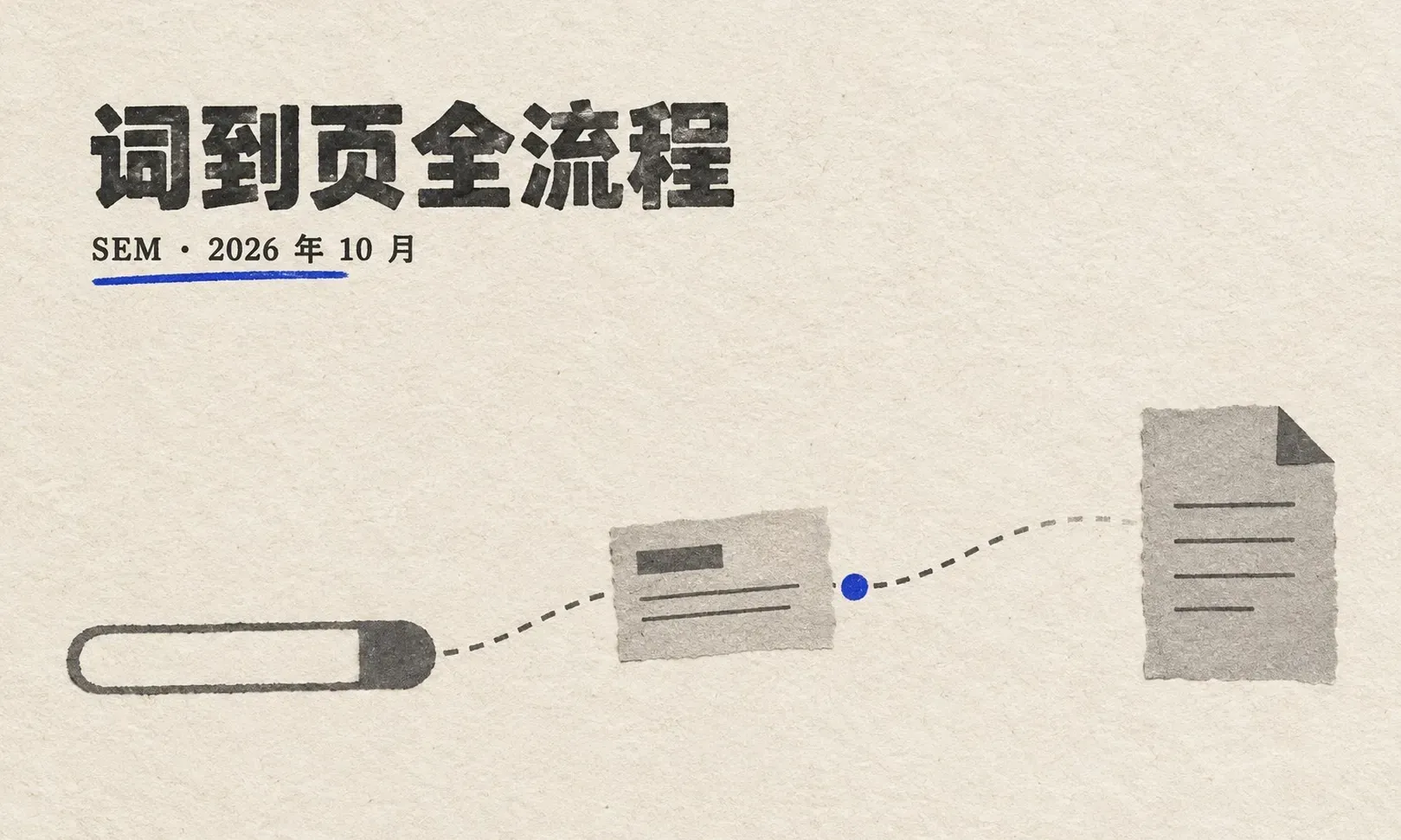
A Google Search Ads workflow hangs on one line, from search intent through keywords, ad groups, responsive search ads, and ad assets, to the landing page that has to deliver on the promise. If any link breaks, everything downstream gets harder. That is why what to do first, and what to avoid, matters more than learning a few more terms.
Here is the order. Step one, choose keywords well; match types and negative keywords decide which searches your ads can appear on. Step two, let the ad catch the intent; responsive search ads and ad assets do the talking on the results page. Step three, let the landing page keep the promise; if the page misses, the first two steps lose their value. Bidding and creative fine-tuning come after all three. Account structure belongs to the Google Ads account setup guide, and conversion tracking sits at the end of the chain in the conversion tracking and attribution guide. This piece walks one search ad from keyword to page. For the strategy-level overview, read the full Google Ads playbook first.
From search intent to keywords and keyword match types
A keyword is a doorway to intent, and one need can arrive through product terms, question terms, brand terms, or competitor terms, each with different commercial value and different ways to receive it. How to research and tier keywords gets its own piece later; here we solve the next step, choosing a match type once the words are in hand.
Modern match type semantics are looser than the old days, and each type covers a band. Broad match covers the widest range, showing your ads on searches related to the keyword's meaning, including searches that do not directly contain it. Phrase match covers the meaning being included, implied meanings allowed, with searches that can be a more specific form. Exact match covers the most specific searches, the narrowest band. The three are a ladder of narrowing coverage, and broader types naturally cover everything narrower plus more, so the real decision is how tight a control you want over this set of words.
One pairing is not optional. Google's documentation stresses that broad match should be used with Smart Bidding, because every query is different and bids need to reflect auction-time signals; opening the tap with broad match means handing bid decisions to the system. The full decision table for match types, and how they interact with budget and negatives, comes in the next piece.
Negative keywords are the purification stage of this line. Negatives run at three levels, ad group, campaign, and shared negative keyword lists. The higher the level, the wider the blast radius, and a shared list is the cheapest way to manage common exclusions across campaigns. Negatives handle misspellings and casing automatically, so no duplicates are needed. The rhythm matters more than the setup. Review the search terms report on a schedule and add irrelevant queries as negatives, rather than finding them after the budget burns. Note that the report shows only part of the story, low-volume queries get grouped or omitted, so treat it as a sampled view.
Ad groups, one intent per group
An ad group is the container between keywords and ads. The rule is one line. Keywords in the same group must be receivable by the same ad and the same landing page. Put waterproof hiking boots and formal leather shoes in one group and no responsive search ad can be right for both; group words by close intent and copy, assets, and landing page line up. Designing ad groups and account tiers is the account structure piece's job; here, just remember one discipline, if the grouping is wrong, every later optimization is patchwork.
Responsive search ads, asset combinations over one-liners
Responsive search ads work by combination. You provide up to 15 headlines and 4 descriptions (minimum 3 headlines and 2 descriptions), and the system combines the most likely effective version for each search; each headline is 30 characters and each description 90, with double-width languages such as Chinese counting two characters each. The asset pool therefore has to satisfy two conditions at once, every asset stands alone, and no combination clashes.
Draw assets from four places, search intent (what the user wants), unique selling points (why you), proof (why believe you), and a call to action (what next). Fold compliance limits in early so nothing gets rejected after launch. Be sparing with pinning, fixing an asset to a specific position trades combination freedom for guaranteed placement, and only compliance requirements or brand constraints are worth that price.
Ad Strength is a diagnostic reference, never a KPI. Google uses it as a quality signal for the asset mix, flagging sparse, repetitive, or narrow pools with a lower rating; the right use is finding improvement directions and letting real business results judge success, not stuffing headlines to raise a score. The full copy testing template comes in a dedicated piece.
Ad assets and Ad Rank, what happens in the auction
Ad assets (sitelinks, callouts, and the rest) complete the ad's appearance together with the creative. In Google's framing, their expected impact is factored into the auction as the expected impact of ad formats and assets. Filling assets in fully and accurately is free competitiveness.
Ad Rank decides two things, whether your ad is eligible at all and where it lands relative to other ads. It is calculated twice per auction, once for eligibility against thresholds, once for position. The factors come in six groups, your bid, the quality of your ad and landing page (rolled up in Quality Score), Ad Rank thresholds, auction competitiveness, the context of the search (device, location, time), and the expected impact of formats and assets. Two implications deserve attention. Thresholds mean a low-quality ad can fail to show no matter the bid, and context means the same ad can perform completely differently across situations.
Put Quality Score back in its place. It is a diagnostic tool, not a direct auction input, scored 1 to 10 at the keyword level and built from three components, expected clickthrough rate, ad relevance, and landing page experience, each rated above average, average, or below average. Use it one way, find the weak component and fix the matching thing; weak relevance points to copy and keyword grouping, weak experience points to the page. Any claim that a score converts directly into a bid or a cost contradicts Google's own documentation.
The SEM landing page, CRO, and keeping the ad promise
The landing page is the most underrated link in the chain. A user arrives from an ad expecting the promise to continue. The first screen has to catch the search intent, the headline should echo the ad copy, proof (cases, data, credentials) and price or delivery information belong within sight, forms take only necessary fields, and mobile rendering plus load speed get checked item by item. All of it serves one goal, confirming the user is in the right place.
The right approach to CRO is layered experiments. First classify the problem, relevance (the wrong people, or the page they did not want) versus conversion (the right people not acting), then design the matching experiment, changing one variable at a time and reading results over a long enough window. Rules of thumb like a few-second load ceiling can inform you, but they do not replace testing on your own site; nor can a Quality Score be converted into a page conversion rate by arithmetic. The complete landing page CRO checklist and experiment design get their own piece.
Search ads optimization and SEM performance metrics, look beyond CTR
Once the account is running, the most dangerous habit is optimizing for clickthrough rate. CTR is a diagnostic metric, a relevance signal, but a high-CTR, low-conversion account is a loss machine, and cheap clicks are not the same as clicks worth buying. Read metrics in two layers. The diagnostic layer covers CTR, the Quality Score components, and search term relevance; the business layer covers conversions, cost per conversion, and lead quality. Only when both layers are healthy is an optimization real.
A live comparison sits right here. In the site's latest review, several pages held positions between 6 and 10 with zero clicks over time; a good position is not a good result, and on the ads side, a good CTR is not a good business. Fix the optimization loop in place. Review the search terms report and negatives first, then read the asset combination experiments, then touch the landing page. Change one class of variable per cycle, record, observe, and start the next round. Work in weeks, not days.
Common pitfalls
Using exact match only, for safety. Over-narrowing gives away large amounts of relevant traffic; the fix is mixing match types by intent and budget, then controlling the edges with negatives.
Setting negatives once and never revisiting. The search ecosystem shifts, and new irrelevant queries keep appearing; this is maintenance, not a one-time setup.
Treating Ad Strength as a KPI. A low rating hints at a weak asset pool, but raising the score does not raise the business; conversions and lead quality are the final judges.
Treating CTR as the only goal. High clicks with low conversions, or cheap clicks with junk leads, are variants of the same mistake; check the business layer first.
Once this line from keyword to page runs, you have a repeatable execution method. The series will unpack the key stations next, keyword research, match type selection, RSA copy testing, and using Ad Rank and Quality Score for diagnosis, each in its own piece.
Related Reading
- The Full Google Ads Playbook, the three-tier overview from strategy to optimization, and where Search Ads fits.
- Google Ads Strategy, Account Setup, and Account Structure, a stable account structure comes before a smooth keyword-to-page run.
- Google Ads Conversion Tracking and Attribution, the data foundation at the end of the chain; set conversion goals right and optimization has a direction.