

An account that runs hot and cold is the most common way a global social media presence falls apart. Three posts in one day when inspiration strikes, then two quiet weeks. Or the opposite, the same asset copy-pasted across every platform, busy everywhere and convincing nowhere. Beyond creative skill, what is scarce is a system.
Building a social media line follows an order. The big map lives in the 2026 Global Social Media Operations Guide. The channel mix was settled in the previous piece, Global Social Media Marketing Strategy. This one answers the next question, how does content keep coming, week after week.
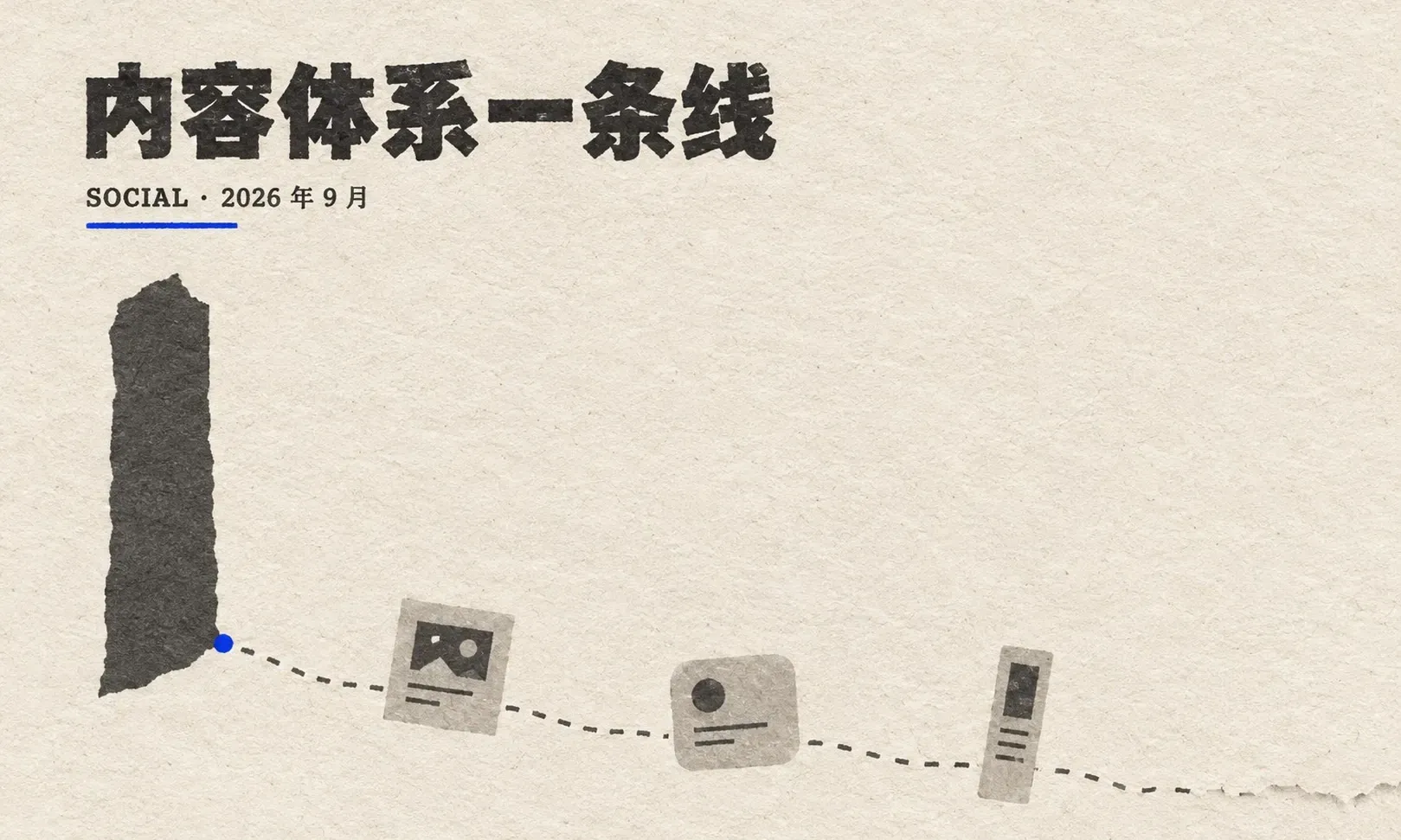
A reusable social media content strategy connects five parts into one line, content pillars, a topic backlog, native formats, publishing cadence, and a production workflow. Once the five run as one line, content output shifts from relying on inspiration to relying on inventory.
Content pillars, deciding what to talk about consistently
Content pillars are three to five topic areas you can supply for the long run. They satisfy three constraints at once, relevant to the business, deep enough to keep going, and genuinely interesting to the audience. Most pillars come from five sources, customer questions, product and service evidence, industry viewpoints, brand stories, and user scenarios. Each pillar also maps to funnel stages, with awareness stages covering the industry and the problem itself, consideration stages covering methods and comparisons, and decision stages covering evidence and cases.
The most practical test for a pillar is whether it can supply content for three straight months. If it runs dry sooner, it is too narrow; if it swallows everything, it is too broad. The right set differs by business; B2B teams tend to build pillars around industry insight and solutions, while consumer brands build around usage scenarios and emotional value. Pair each pillar with ten or so expandable questions, and the base of your content strategy holds.
The topic backlog, turning ideas into inventory
The backlog is the buffer between ideas and publishing. Collect from daily sources. How users phrase things in search, what peers discuss on platforms, what sales and support keep hearing, what evidence the product recently produced, and what competitors are saying. Collect without judgment, then score before anything enters the queue.
The scoring sheet stays simple. Rate each idea one to five on four dimensions, business relevance, audience fit, producibility, and timeliness. Ideas below the threshold wait in observation; near-threshold items get reviewed together so debates are settled in the room. Every entry carries a status label, idea, drafting, in review, scheduled, or published, so the queue stays legible and anyone on the team can pick it up.
The health check for a backlog has one number. Always keep two to four weeks of publishable inventory. Refill before the buffer runs dry, rather than digging through chat history the night before a post is due.
Native formats, one core message in many expressions
The same brand message needs to speak each platform's language. Text posts carry opinions and conversation, carousels suit steps and lists, short video handles hooks and demos, and long video or live streams carry depth and trust. Get clear on each format's job before adapting anything.
Cross-platform adaptation breaks into four steps. First, lock the core message and its evidence, facts, data, and customer cases, which every platform shares. Second, pick the lead format per platform. Third, restructure for the platform's language. Short video moves the conclusion into the first three seconds, carousels let the first image do the headline's work, text posts make the opening line stand on its own. Fourth, add platform-native elements such as tags, captions, and cover text.
The classic mistake is mistaking adaptation for duplication, a sixty-second vertical video dropped unchanged into every channel, one version stretched across everything. Real adaptation retells the same message inside a different context. The time saved by copy-paste comes back in another form.
Publishing cadence, sustainability before frequency
Cadence design starts with the minimum sustainable line, then adds from there. Assess how much content the team can reliably ship each week and set that as the baseline, say three posts with one video among them. Below the baseline there are no excuses; above it, volume can grow.
Structure it with monthly themes and weekly slots. Monthly themes rotate through the pillars, while weekly slots stay fixed, an industry watch on Monday, a method breakdown on Wednesday, a case review on Friday, for example. Slots give production a rhythm and the audience a memory.
Cross-time-zone teams treat the content calendar as the single source of truth, with every entry carrying a publish window, platform, owner, asset status, and review status. Do not treat any fixed best time to post as gospel. Active windows differ by market and audience, so calibrate from your own account data and write it into the calendar.
The production workflow, from personal skill to team capability
A workflow solves the problem of output depending on one person. Five stages, topic review, production, review, scheduling and publishing, and retrospective filing. Define the inputs and outputs of each stage. Topic review outputs a locked message and evidence list; production adds assets and copy; review checks three lists, fact verification, copyright and asset licensing, and platform rules including multilingual accuracy.
A shared asset library is where the workflow gains speed. Keep reusable data, customer cases, product demos, and expert points in one place, labeled with usage scope and expiry, and source new content from it first. Leave at least two working days for review, finish final approval the day before the publish window, and pin handoff points into the calendar for distributed teams. Review records and retrospectives feed the next cycle. The longer it runs, the thicker the library, and the lower the unit cost of each piece.
Common pitfalls
Copy-pasting one asset across every platform. Platform registers differ; the same content reads like an ad in short video and like a monologue on text-first networks. The time saved comes back in performance and account tone.
Relying on inspiration without inventory. Inspiration is lumpy, publishing is weekly, and the buffer in between has to exist. When inventory runs dry, quality gives way.
Setting frequency beyond production capacity. Writing five posts a week into the calendar to chase volume ends in a third-week dropout. The goal of cadence is continuity, not a sprint.
Skipping review. A factual error, an unlicensed asset, or multilingual copy that breaks platform rules can each turn one post into an incident. Review is the seatbelt of scaled production.
Once the five parts run together, content output gets a stable skeleton. No system has to be perfect on day one; aim for a working process in the first two months, then optimize quality item by item. The series continues from here, with dedicated pieces on content pillars and the topic backlog, native format adaptation, and the content calendar and cross-time-zone workflow.
Related Reading
- 2026 Global Social Media Operations Guide: Platform Selection and Strategy for B2B and B2C Brands, the root of the series, where the full picture starts.
- Global Social Media Marketing Strategy: Goals, Audiences, and Channel Mix, pick the channel mix first, build the content system second.
- Google Just Added Two New Rulers for SEO: AI Visibility + Social Search, and Content Assets Finally Have One Yardstick, where the content system meets measurement once it is running.