


1. Why global social media operations matter so much
As globalization deepens, social media has become one of the most important bridges between brands and consumers. It is also a major factor in whether a company can truly open up international markets. Strong social operations can raise awareness, increase user stickiness, and create direct interactions with overseas audiences, giving brands a clearer understanding of what those users actually need. Yet in practice, most brands run into the same problems: the account is live but nobody sees it, followers are low quality, and even after publishing hundreds of posts there are still no real inquiries.
Xiaomi offers a good example of what effective social strategy can do. By tailoring its approach and using platform-native tactics, Xiaomi expanded successfully across global markets, especially in India and Southeast Asia. On Facebook and Twitter, it consistently promoted new launches and campaigns. It also encouraged user-generated content by inviting customers to share product experiences and creative content. That approach did not just increase exposure. It helped Xiaomi build stronger relationships with users and accumulate a large base of loyal followers.
But Xiaomi's path cannot simply be copied. As overseas markets become more diverse, building an appropriate and effective social strategy becomes a serious challenge. That is why String Global has put together a practical guide to overseas social media operations to help brands run their accounts more effectively.
2. How B2B and B2C brands should choose the right global social platforms
There are many social platforms worldwide, and each one differs in audience, behavior, and product design. Choosing the right platform is the first step toward success. Below are several of the most important channels.

Facebook: still the largest and most widely adopted social platform in the world. Its users span a wide range of ages and geographies, and the platform offers powerful ad-targeting and analytics tools. It is suitable for brand building and community management, making it the default first stop for many B2C and B2B brands going global. It is not just a traffic pool. It is your brand's digital headquarters.
💡 String Global insight: whether you are a B2C brand in categories such as home, beauty, or fashion, or a B2B business looking for early lead generation, Facebook remains essential. We recommend combining page operations with group-based engagement and using its retargeting engine to re-engage users who visited your website but did not convert.

Instagram: centered on high-quality images and Reels, Instagram is one of the best platforms for visual storytelling. Its audience skews younger and tends to care deeply about aesthetics, identity, and brand narrative.
💡 String Global insight: ideal for B2C categories such as fashion, beauty, travel, and design-led home products. Influencer collaboration works especially well here, and Stories can be used to maintain frequent, low-friction touchpoints that shorten the path from curiosity to purchase.

Twitter / X: a real-time conversation platform built around short posts and fast-moving information. It concentrates news, industry commentary, and public conversation, and information spreads quickly.
💡 String Global insight: a key platform for technology hardware, AI software, gaming, and similar categories across both B2C and B2B. By joining trending conversations with a sharp, useful, or professional perspective, brands can break out of their usual audience bubble and expand visibility.

LinkedIn: a professional and commercial network used by executives, managers, employees, and industry specialists across sectors. LinkedIn is more than a recruiting tool. It is the world's largest business social platform and often a lead-generation machine for B2B companies going global.
💡 String Global insight: if you are in machinery, SaaS, electronic components, or other complex B2B categories, LinkedIn should be one of your primary battlefields. Publishing white papers, factory footage, and expert perspectives helps you reach decision-makers directly.

TikTok: the dominant short-video platform, especially among younger users. It is built around creativity, entertainment, and high engagement.
💡 String Global insight: TikTok's recommendation algorithm is exceptionally strong at pushing creative short-form content into new audiences. It is especially powerful for B2C categories such as FMCG, small appliances, and trend-driven toys, where impulse purchase behavior is common and virality can create breakout products quickly.

YouTube: the largest video-sharing platform in the world, built mainly around long-form content and serving users of almost every age group. It has high retention and depth.
💡 String Global insight: for products with high average order values or long decision cycles, YouTube reviews, demos, and educational content are essential for reducing trust barriers. That makes it especially suitable for both B2C and B2B brands in 3C electronics, smart devices, education, and similar categories.

Reddit: one of the most important sources of authentic word of mouth online. It also skews younger and is structured around deep, topic-specific communities. Its culture rewards honesty and real contribution.
💡 String Global insight: especially useful for B2C and B2B brands in consumer electronics, gaming, outdoor gear, and developer tools. By offering technical support, collecting feedback, and participating in discussion threads meaningfully, brands can build real trust. Once a community accepts you on Reddit, the resulting reputation lift can be significant.
3. High-conversion overseas social media management strategy: content and interaction
The right strategy is the heart of social operations. It helps brands attract attention, increase engagement, and build long-term value.
1. Content strategy: attract and retain the right audience with useful content
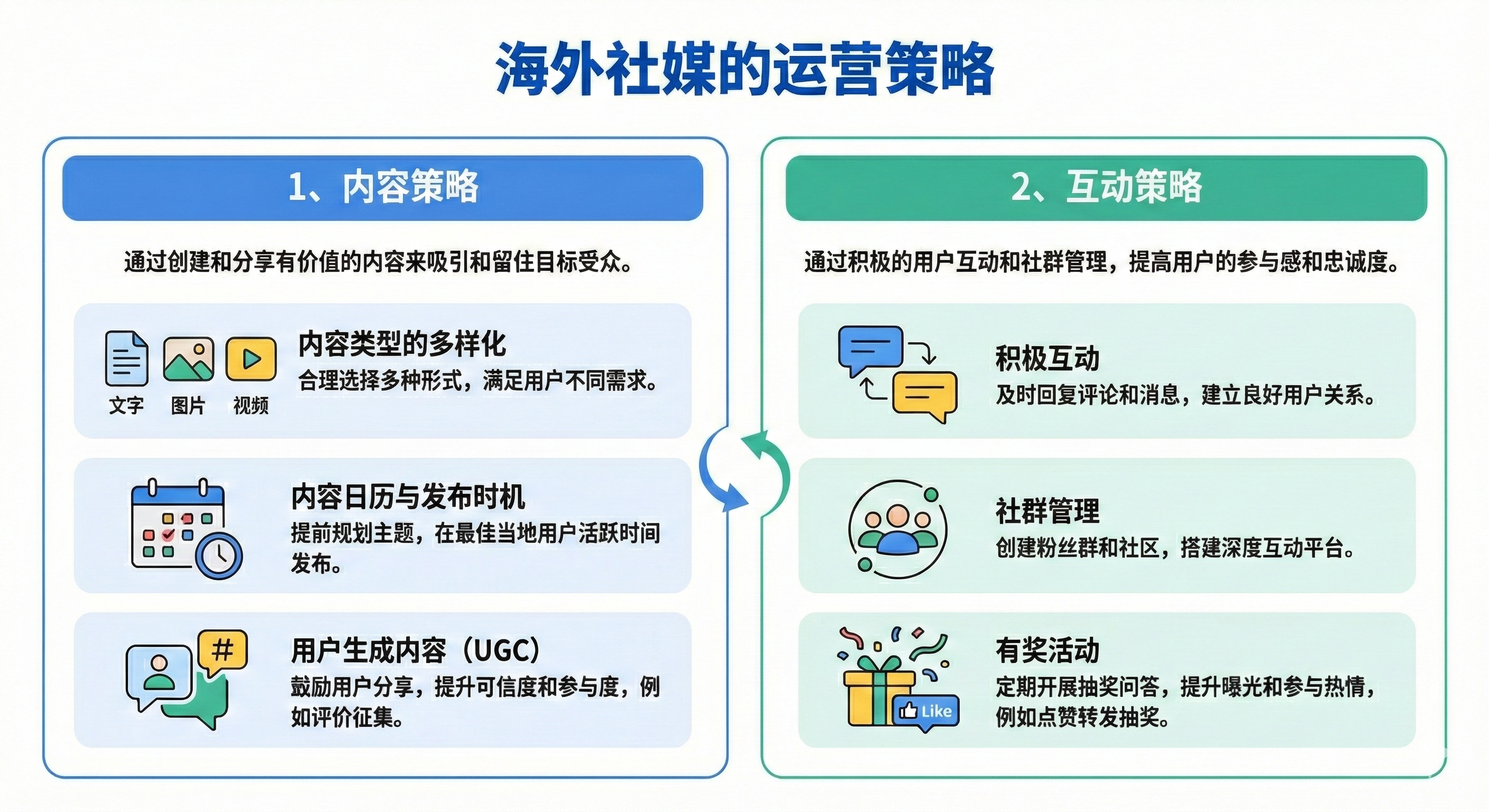
Diversify content formats: based on platform behavior and audience preferences, mix text, images, and video intelligently to meet different user needs.
Content calendars and publishing timing: build a publishing calendar so content themes stay consistent over time. Match post timing to local activity windows so content reaches the target audience when they are actually online.
User-generated content: encourage users to share brand-related content. UGC raises credibility and participation at the same time. For example, brands can launch review campaigns or invite users to share experiences under a branded hashtag.
2. Interaction strategy: raise participation and loyalty through active community management
Respond actively: comments and discussion are one of the core ways brands communicate with users on social media. Fast, thoughtful replies help build both trust and perceived reliability.
Community management: create fan groups, private communities, or similar spaces where users can interact and share experiences. The brand can distribute exclusive content and collect feedback while deepening the relationship.
Incentivized engagement: giveaways, Q&A activities, and similar mechanics can quickly raise reach and participation. Asking users to like, comment, or repost in exchange for an entry can produce a short-term awareness lift when used carefully.
4. How to evaluate the quality of overseas social operations
There are many ways to run social media, but how should we evaluate whether the work is actually good? A useful framework should not just pile up vanity metrics. It should use clear KPIs and meaningful dimensions to assess business impact.
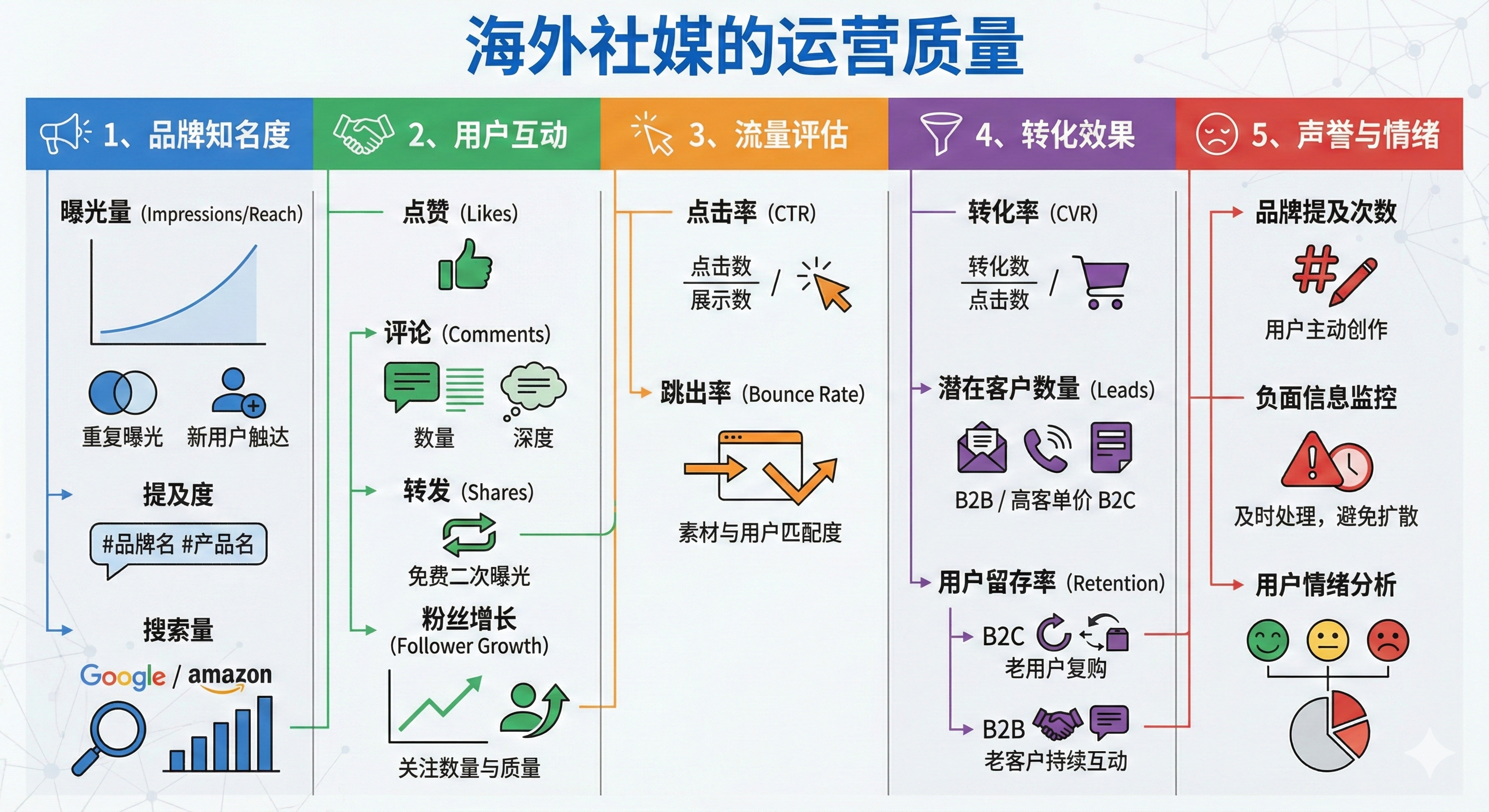
1. Brand awareness
Exposure: use impressions and reach to evaluate visibility, while also watching repeat exposure and new-user reach.
Mentions: measure how often users proactively mention the brand name, product name, or relevant hashtags.
Search volume: after seeing content on social media, some users search for the brand name on Google, Amazon, or elsewhere. That branded-search volume is an important signal and can be tracked through analytics tools.
2. User engagement
Likes: a basic signal that users approve of or notice the content.
Comments: comment volume shows participation, while comment depth often signals stronger trust and a more real user experience with the brand.
Shares: sharing means users are willing to recommend the content to others, generating free secondary exposure.
Follower growth: analyze the growth curve to see which content themes or campaigns attract more followers. Focus not just on quantity, but also on quality.
3. Traffic quality
Click-through rate (CTR): CTR equals clicks divided by impressions. It reflects how well the content and audience match.
Bounce rate: if users land on the site and leave immediately, the mismatch may be between the content promise and the landing-page experience, which indicates that strategy adjustments are needed.
4. Conversion outcomes
Conversion rate (CVR): CVR equals conversions divided by clicks. This measures real downstream outcomes such as purchases, registrations, and tracked actions.
Lead volume: for B2B companies or high-ticket B2C brands, users may not buy immediately. In those cases, lead capture such as email or phone collection becomes the more realistic intermediate goal.
Retention: for B2C, this usually means repeat purchase. For B2B, it can mean whether existing customers continue to engage with and share the brand's content.
5. Reputation and sentiment
Brand mention volume: user-generated mentions tied to the brand reflect how much real mindshare the brand has earned.
Negative feedback monitoring: negative feedback is not fatal. Ignoring it is. If users complain about product quality and the brand fails to respond in time, those complaints can spread and hurt the brand image.
Sentiment analysis: analyze whether mentions and comments are positive, negative, or neutral. This helps teams understand emotional perception around the brand.
5. Final thoughts
Global social media operations are complex and require ongoing optimization. Successful execution depends not only on understanding the market, but also on combining platform characteristics with data analysis to strengthen brand reach, awareness, and competitiveness over time.
In the years ahead, social media will remain a crucial channel for brand communication, user interaction, and business growth. But it will also keep evolving and creating new challenges. As a professional global marketing team, String Global helps brands build a multi-touch social media matrix so they are not only seen, but remembered.