

1. Why Twitter/X accounts enter risk control
Twitter has been renamed X, but many Chinese operations teams still habitually call the platform Twitter. No matter how the name changes, the core of account risk control has not changed: the platform continuously judges whether an account is real, stable, and transparent, whether it is amplifying content through abnormal methods, and whether it brings safety or experience risks to other users. When an account is restricted, it is not necessarily because of one specific piece of content. It is more likely the result of login environment, profile credibility, content repetition, engagement rhythm, link safety, and historical violation records adding up together.
From a practical operations perspective, many account abnormalities do not happen suddenly. A new account frequently changing profile details right after registration, following many accounts in a short period of time, continuously posting external links, being repeatedly logged into by multiple people in different regions, or using an overly templated avatar and bio may not seem serious when each action is viewed alone. But when combined, these actions can easily form a high-risk profile. Mature account risk control needs to reduce abnormal signals during account creation, profile completion, content publishing, and team collaboration, instead of waiting until the account is locked, visibility-limited, or suspended before trying to fix it.
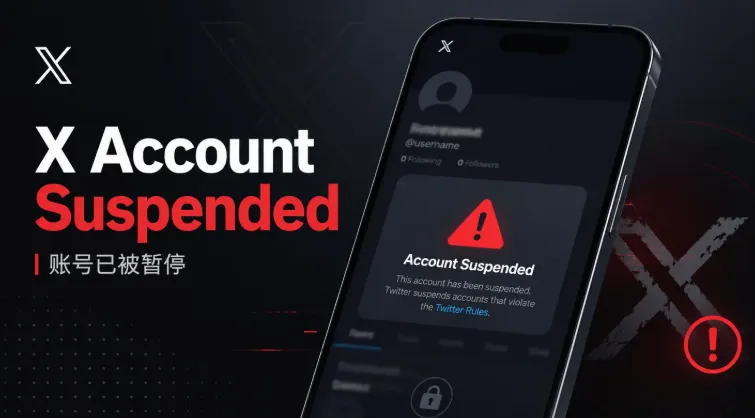
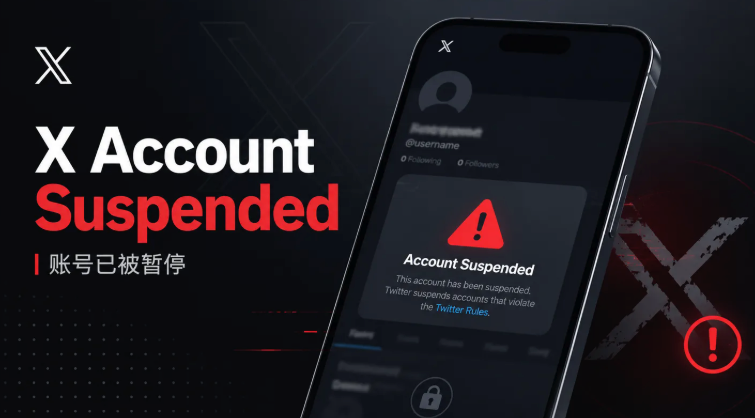
X's official authenticity policy clearly states that the platform does not allow inauthentic accounts, inauthentic behavior, or inauthentic content to manipulate the platform or disrupt services. Its account suspension guidance also mentions that spam accounts, account security risks, and abusive behavior may all lead to account suspension. Therefore, our String Global team will use our business experience to share the risk-control system we use for Twitter accounts, hoping to help readers achieve their own operating goals.
2. Operating environment
(1) Keep the device environment as fixed as possible
The point most likely to trigger risk in the early stage of an account is frequent change. Logging in on a computer today, switching to a phone tomorrow, and using another browser the day after tomorrow may look like normal team collaboration, but for the platform, continuous changes in device, browser, system, and login behavior increase the cost of identification. Brand accounts and business accounts should establish a fixed device or fixed workstation from the beginning. Common browsers, common systems, and common login methods should remain as stable as possible. Before the account's strength rises, avoid frequent changes.
If a team needs multi-person collaboration, the main operating device can be responsible for daily posting, commenting, and profile maintenance. Other members can submit content through content sheets, asset libraries, and collaboration tools, and the main account operator can publish it uniformly. Larger teams can also use compliant enterprise collaboration tools and permission management methods to avoid multiple people directly taking the account password and logging in from everywhere. The benefit of doing this is not to evade risk control, but to make the account behavior look more like a stable brand operating entity.
(2) Keep the network environment stable and clean
Cross-border operations often encounter network environment issues. The key here is to keep the network source stable and avoid large regional drift within a short time. VPN use needs special attention here: clean and fixed nodes are a very important point, and many people trigger risk control because they fail at this step. If an account has long been operated in one country or region, then suddenly logs in from multiple countries within one day and continues to change profile details, post external links, follow accounts, and send direct messages, it can easily be judged as abnormal access or an account security risk.
A safer approach is to establish clear operating ownership for different accounts. A brand English account, regional market account, support account, and founder IP account can each have their own fixed use scenario and login environment. Do not let multiple unrelated accounts share low-quality public networks for long periods, and do not operate accounts in unknown shared environments. The messier the network environment, the higher the probability of mistaken restriction, account compromise, and risk control. Here we recommend using a fingerprint browser approach to manage IPs and accounts and to classify them properly. Readers interested in the detailed technical steps can contact us.
(3) Do not let the login rhythm look like a machine or a compromised account
Normal account login behavior usually has a rhythm. Operators handle content, reply to engagement, and check notifications during fixed daily periods, which is natural. Higher-risk behavior is logging in and immediately changing the password, avatar, email, and bio in sequence, then quickly following accounts, posting, sending direct messages, and deleting content. This kind of behavior is very similar to account takeover after compromise.
If an account really needs to change profile details, adjust positioning, or be transferred to a new team for management, it is better to complete this in stages. On the first day, confirm the email, password, and two-factor authentication. On the second day, change the avatar, bio, and link. On the third day, resume content publishing. For old accounts with historical content, it is even more important to avoid changing the account into a completely different business direction overnight. After making changes, before carrying out operating goals, we recommend waiting calmly for 48 hours. This is a safer amount of time. Haste makes waste, and progress should be gradual.
(4) Keep team operation records
Risk-control handling and appeals often require looking back. Who changed profile details and when, on which day a certain official website link started being used, whether a third-party tool was recently authorized, whether abnormal direct messages or automated follows appeared: if this information is not recorded during normal operations, it is very hard to judge the cause when an account becomes abnormal.
We recommend that teams build an operation log for every key account, recording the account purpose, responsible person, login device, main external links, profile update time, authorized tools, abnormal prompts, and appeal records. The log does not need to be complex, but it should explain the continuity of account behavior. For brand accounts and client accounts in particular, the operation record itself is part of the account asset. Although this cannot fully guarantee that restrictions can be lifted smoothly after risk control is triggered, it can become strong evidence in appeal materials and gain higher weight in a comprehensive review. At the same time, the data can also serve as an analysis foundation and auxiliary data for judging the operating direction.

3. Profile completeness
(1) Keep avatar, display name, and username consistent
The first layer of profile credibility comes from visual consistency. The avatar, display name, username, bio, official website link, and pinned content should point to the same identity. Do not make the avatar look like a personal account, the bio look like an ecommerce account, and the link jump to a completely unrelated website. Brand accounts should use a clear brand mark or brand-related image. Personal IP accounts should use a real, stable, and long-term consistent avatar.
X's authenticity policy specifically mentions that using fabricated identities, stolen identities, or misleading profile information to deceive others creates risk. This does not mean all accounts must use real names. It means accounts cannot intentionally impersonate other people, organizations, or brands. For commentary accounts, fan accounts, news accounts, and regional accounts, the purpose should also be clearly explained in the bio to avoid making users think the account is an official account.
(2) Use the bio to explain what the account does
Many account bios only contain a few keywords, such as web3, airdrop, crypto, marketing, and AI tools. This looks very much like a batch account. A better bio should answer three questions: who the account is, what content it mainly publishes, and why users should follow it.
For example, a cross-border marketing tool account can write: Helping global teams manage social content, campaign updates and customer communication across markets. This kind of bio is more natural than keyword stuffing and is easier to keep consistent with later content. When Chinese operations teams write English bios, they do not need to pursue complex sentence patterns. Clarity and stability matter more.
(3) Make sure the official website link and landing page support the account identity
External links are also an important risk-control point. If the homepage link cannot be opened, redirects multiple times, the landing page has no brand information, the domain was newly registered, or the page is full of pop-ups and download buttons, the account's credibility will be reduced. Brand accounts should preferably use the official main domain or a clear campaign page, and the page should show the brand name, product description, contact information, privacy policy, or terms of service.
If the account is used for content distribution, the proportion of external links should be controlled. A new account should not attach links to every piece of content from the beginning, and should not frequently switch among different domains. Link content and account positioning should be consistent. Promotion pages, signup pages, download pages, and campaign pages should all have clear explanations. X's authenticity policy lists malicious, deceptive, or harmful links as risk content. In actual operations, external link quality often directly affects account health.
(4) Use a pinned post to supplement account background
A pinned post is the most important explanatory space outside the profile page. If a new account has a short bio and little historical content, the pinned post can explain identity, content direction, and contact methods. A pinned post does not need to read like an advertisement. It can simply introduce what content the account will continue to share, which users it serves, and what official entry points exist.
For regional market accounts, support accounts, and campaign accounts, the pinned post is especially important. It can explain why the same brand has multiple accounts and can reduce the chance of being mistaken for an impersonation account.

4. Content and engagement
(1) Do not make content overly repetitive
Content repetition is one of the most common risks for Twitter/X accounts. Repeatedly posting the same copy, synchronously publishing identical content across multiple accounts, or mass-posting around popular hashtags may bring exposure in the short term, but in the long run it can easily be classified as content spam or coordinated behavior.
When operating multiple accounts, each account needs independent positioning. The main brand account can post product updates, the founder account can publish opinions and industry observations, the regional account can publish local-language content, and the support account can handle user problems. Even when promoting the same campaign, the copy should be rewritten according to each account's positioning instead of copying the same paragraph.
(2) Keep engagement grounded in real context
Comments, reposts, likes, follows, and direct messages are all normal interactions. But if they are done in large volumes over a short time, or if comments have nothing to do with the original post, they become engagement spam. Using the same script to reply to many popular posts, or using multiple accounts to like, repost, and comment on each other to raise metrics, can easily trigger risks related to authenticity and platform manipulation.
A safer method is to return engagement to the context itself. When replying to someone, first understand their content, then express a specific viewpoint. When reposting, add your own explanation. When sending direct messages, confirm that the other person has a clear need or that there has already been an interaction foundation. This looks slower, but the account will be healthier in the long run.
(3) Publish external links with rhythm
Many business accounts aim to drive traffic, but a new account that continuously publishes signup links, download links, and campaign links right after creation carries high risk. External links need content groundwork. First use viewpoints, cases, tutorials, and product scenarios to build the account topic, then guide users to the official website or campaign page at appropriate points.
Do not repeatedly push the same link within a short period of time. Different accounts should not push the same link under the same topic at the same time. For important landing pages, check before publishing whether the page opens normally, whether there are security warnings, whether there are multiple layers of redirects, and whether it matches the post description.

5. Summary of common Twitter/X rule violations
This part can be called a risk map. It is not a word-for-word translation of all rules, but a translation of the clauses operations teams most often step on into understandable scenarios.
(1) Authenticity and platform manipulation
This type of risk mainly revolves around inauthentic accounts, inauthentic behavior, and inauthentic content. Common scenarios include registering accounts in batches, using fabricated identities to deceive users, using multiple accounts to amplify the same content, using multiple accounts to participate in the same poll or topic, and manufacturing popularity through repeated engagement. X's official authenticity policy allows multiple accounts for different purposes such as business, regional, interest, and project uses, but the premise is that identity, purpose, and content must not be repetitive, deceptive, or manipulative.
(2) Content spam
Content spam usually appears as large amounts of repetitive, irrelevant, or unsolicited content. Sending the same copy at high frequency, abusing popular hashtags, repeatedly posting unexplained links, deleting and reposting the same content, and replying to popular posts with irrelevant content can all fall into this category. Content spam does not require machine automation. Manual batch operations can also be judged as abnormal.
(3) Engagement spam
Engagement spam mainly occurs around follows, likes, reposts, comments, lists, and direct messages. Buying or selling engagement, exchanging likes and reposts, following and then quickly unfollowing, following many irrelevant accounts, using third-party services to inflate data, and using multiple accounts to boost each other's metrics are all high-risk behaviors. When teams operate multiple accounts, the most easily overlooked issue is excessive mutual support among accounts. In the short term it may look like matrix collaboration, but in the long term it can become abnormal amplification.
(4) Malicious links, scams, and phishing
External-link violations are very common. If links involve phishing, malware downloads, deceptive redirects, fake offers, or inducing users to hand over passwords or private keys, they can trigger serious risk. Even if there is no intentional scam, poor landing page experience, complex redirect chains, or domains flagged by security systems may cause posts to be limited or accounts to be reviewed.
(5) Impersonation, misleading profiles, and false identities
Accounts do not necessarily need to display a real name, but they cannot impersonate other people, organizations, or brands. Using the same avatar, similar usernames, misleading bios, or stolen brand assets will increase the probability of reports and restrictions. Fan accounts, commentary accounts, and news accounts can exist, but the identity relationship should be clearly stated in the display name and bio, and users should not be made to think the account is official.
(6) Account compromise and abnormal authorization
Account compromise itself will also enter risk control. Abnormal direct messages, abnormal follows, unauthorized posts, password failure, email change notifications, and unfamiliar third-party app authorizations may all indicate that the account has been taken over. X officially recommends that when users can still log in, they should immediately change the password, confirm email security, revoke unfamiliar third-party apps, and delete abnormal content posted during the compromise period.
(7) Ban evasion
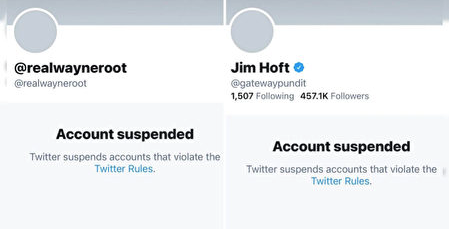
If an account is suspended because of violations, then creating a new account to replace it, renaming an old account to continue using it, or asking someone else to operate the same violating entity may all be considered ban evasion. For teams, when an account is suspended, do not rush to switch accounts and continue the same content strategy. First determine the violation reason, handle the original account appeal or remediation, and then decide the next operating arrangement.
(8) Attacks, harassment, threats, or abusive behavior
Attacks and harassment do not only happen in personal arguments. Brand accounts can also enter risk zones because of improper replies. Repeated malicious mentions of a user, inciting others to attack, posting threatening language, using insulting expressions, or publicly shaming someone can all trigger relevant policies. When brand accounts handle complaints and disputes, the tone should remain restrained. Try to guide users to customer service channels and avoid escalating conflict in public comment areas.
(9) Violent content, sensitive media, and misleading media
X allows some sensitive or graphic content to exist with appropriate labeling, but threats, incitement, praise of violence, or displaying violent content in highly visible areas will create risk. AI-generated images, edited videos, news screenshots, and old images reposted as new content also need context. If the presentation makes users misunderstand the time, location, people, or source of an event, it may be regarded as misleading media.
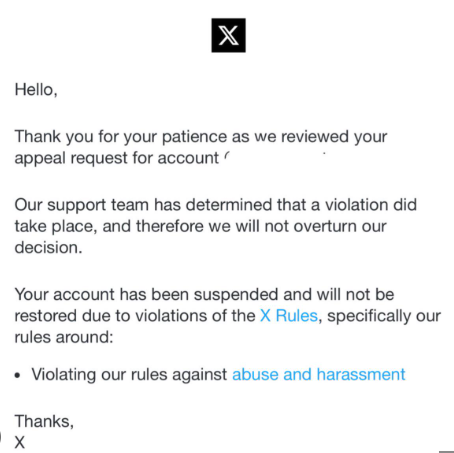
6. Handling order after an account becomes abnormal
(1) First identify the abnormality type
After an account becomes abnormal, do not immediately submit appeals repeatedly. First look at the platform prompt: is it asking for email or phone verification, or does it say the account is locked, features are limited, content visibility has declined, a link has been warned, or the account is suspended? Different abnormalities correspond to different handling paths.
If it is only a verification prompt, usually complete verification first. If the account is suspected of being compromised, first change the password, check the email, and revoke third-party authorization. If it is a specific content violation, first confirm which content triggered the issue. If it is an account suspension, then prepare appeal materials.
(2) Organize account facts
Appeals are most afraid of vagueness. Platform reviewers need clear facts: what the account is used for, what recent actions were taken, whether any third-party tool was authorized, whether there were signs of compromise, whether abnormal content has been removed, and whether security settings have been strengthened.
Before submitting, prepare the account username, registered email, account purpose, last normal login time, abnormality occurrence time, possible cause, and corrective actions already taken. The more specific it is, the more it looks like a real account holder.
(3) Do not repeatedly submit different explanations
Some teams say in the first appeal that the account was compromised, say in the second appeal that it was a system mistake, and say in the third appeal that it was employee misoperation. This reduces credibility. Before appealing, first judge the main cause, then explain around the same factual line. If the cause is truly uncertain, you can say the account may have been restricted because of abnormal login or misjudgment, but do not fabricate false circumstances.
Continue supplementing appeals after a failed appeal
A failed first appeal does not mean the account has no chance of recovery. In actual cases, there are indeed situations where review only passes after multiple submissions, especially when the account was misjudged by the system, restrictions were triggered by abnormal login, or profile details or links were misidentified as risky. Clearer supplementary explanations later may give reviewers a chance to re-evaluate. For example, one of our String Global clients still obtained an account restoration after seven appeals.
The key to continuous appeals is not simply submitting the same paragraph repeatedly, but adding new information around the same factual line each time. For example, the first appeal can explain the account purpose, while the second can add the recent login environment, whether the password was changed, whether third-party authorization was revoked, and whether abnormal content was deleted. If account compromise is suspected, you can add the specific abnormal time, security measures already taken, and the reason you hope the platform will review again. The more specific the appeal content, the easier it is to show that the account is indeed maintained by a real user.
It should be noted that continuous appeals also need rhythm control. Do not submit a large number of identical appeals within a short period of time, and do not change the explanation each time. A safer method is to wait for the platform's reply, then organize the next appeal based on that reply. After an appeal fails, review whether the previous explanation was too vague, whether it lacked the account purpose, or whether it failed to explain the abnormal cause, then submit a more complete version.
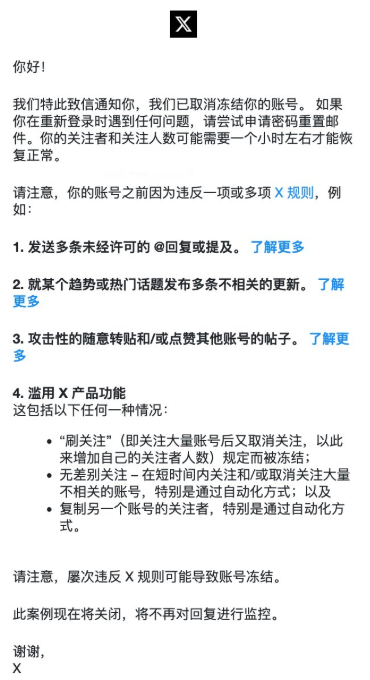
7. Appeal templates
The templates below use short, direct, replaceable wording as a reference for readers. They are closer to common platform appeal forms. However, readers should remember not to copy entire sections directly. Replace the information in brackets with the real situation.
(1) Account mistaken for spam or automation
Dear X Support Team, My account @USERNAME appears to have been suspended or limited by mistake. This account is used for BRAND / BUSINESS / PERSONAL CONTENT. I do not use it for spam, automation, fake engagement, or platform manipulation. Recently, I mainly posted content about TOPIC and interacted with users in a normal way. If any activity looked unusual, it was not intentional and I am willing to review and remove anything that may have caused confusion. Please review my account again. I will continue to follow the X Rules and keep my account activity authentic and compliant. Thank you.
(2) Account compromise or abnormal authorization
Dear X Support Team, I believe my account @USERNAME was compromised or accessed without my permission. I noticed UNEXPECTED POSTS / DMs / FOLLOWS / LOGIN CHANGES on DATE. I have already changed my password, secured my email address, reviewed third-party app access, and removed any activity that I did not authorize where possible. This account belongs to me and is used for ACCOUNT PURPOSE. Please help review the restriction and restore access if possible. I can provide any additional information needed to verify ownership. Thank you.
(3) Link mistaken for unsafe content
Dear X Support Team, The link DOMAIN / URL shared by my account @USERNAME appears to have been flagged by mistake. This URL is our official website / campaign page / product page. It does not contain malware, phishing content, deceptive redirects, or misleading claims. The page provides information about PAGE PURPOSE and is operated by BRAND / COMPANY. I have checked the page and fixed any possible technical issues that may have caused confusion. Please review the URL again. Thank you.
(4) Profile or identity mistaken for impersonation
Dear X Support Team, My account @USERNAME may have been restricted due to a profile or identity misunderstanding. This account represents BRAND / PROJECT / PERSONAL IDENTITY and is not intended to impersonate any person, company, or organization. I have updated / am willing to update the profile name, bio, avatar, and website link to make the identity clearer. Please review the account again. I will make sure the profile remains transparent and does not mislead users. Thank you.
(5) Account restricted because of multiple-account or coordination concerns
Dear X Support Team, My account @USERNAME was limited or suspended, possibly due to a misunderstanding related to multiple accounts. This account has a separate purpose: ACCOUNT PURPOSE. It is not used to artificially inflate engagement, manipulate trends, or duplicate content across accounts. I will make sure each account has a clear identity, separate content plan, and compliant activity. Please review this account again. Thank you.
Before submitting a template, check three points again: whether the account purpose is clear, whether the abnormal time is specific, and whether the corrective actions are real. The English does not need to be complicated. The shorter and more focused it is, the easier it is for reviewers to understand.

8. Operating rhythm for new accounts and brand accounts
(1) The first seven days of a new account
The goal of the first seven days of a new account is not fast follower growth, but building a normal account profile. First complete the avatar, bio, official website link, and pinned post, then publish several pieces of basic content around the same topic. At this stage, the account can follow a small number of highly relevant accounts and conduct a small amount of real engagement, but large-scale following, dense direct messages, and continuous external links are not recommended.
(2) Day eight to day thirty
After the account has basic profile information and content, publishing frequency can gradually increase. Content should mix opinions, cases, tutorials, product explanations, and industry comments, not only advertisements. Engagement can begin to participate in relevant topics, but the posts should be truly relevant. Do not use the same script to spam comments. External links can begin to appear, but they should preferably come with complete explanations instead of being thrown out alone.
(3) Mature brand accounts
For mature brand accounts, the focus is stability and consistency. Teams need to maintain fixed content columns, a fixed customer service reply style, fixed campaign publishing processes, and fixed security check mechanisms. The more important the account is, the less it should rely on temporary operations. For example, before changing operators, modifying the official website link, connecting a third-party tool, or launching an ad campaign, a risk check should be done.
(4) Account matrices
Account matrices most need to avoid homogenization. Multiple accounts can serve the same brand, but each account needs a different purpose. The main brand account talks about brand and products, regional accounts talk about local markets, support accounts solve problems, founder or employee accounts express opinions, and campaign accounts carry short-term projects. As long as the purpose is clear, the content is different, and engagement is natural, multiple accounts are not necessarily a problem. What truly causes problems is using multiple accounts for repetitive content and repetitive engagement.

9. Daily risk-control checklist
Daily checks do not require long reports every day, but key accounts should be reviewed at least once a week. Check whether the account profile is still clear, whether the official website link opens normally, whether recent content is overly repetitive, whether comments and direct messages show high-frequency templated wording, whether there are unfamiliar third-party authorizations, whether any security reminders have been received, and whether there have been abnormal logins or abnormal profile changes.
If the account is used for customer service, also check whether public replies are too emotional, whether user personal information is being placed in public comments, and whether users are guided to the correct support channel. If the account is used for campaign promotion, also check whether campaign pages have expired, whether offer information is accurate, and whether the landing page matches the post description.
Many risk-control problems do not happen because operators do not know the rules, but because there is no fixed process. Managing account environment, profile information, content, engagement, external links, authorizations, and appeal records in the same sheet can clearly reduce misoperations and repeated mistakes.
10. Conclusion
Twitter/X account risk control is not a single-point trick, but a method of account asset management. A stable operating environment makes account behavior more continuous, complete profile information makes the account identity more credible, clear content positioning makes the account less likely to be misjudged, and a reasonable engagement rhythm makes the account closer to a real user.
For brands and cross-border teams, account safety and growth are not in conflict. The more you want to operate long term, the more you need to value risk control. In the short term, a cautious process may make growth slower. In the long term, it can reduce account suspensions, link restrictions, appeal failures, and client asset losses. Only when an account can continue publishing, continue engaging, and continue being trusted by users does it have real operating value. We hope these tips and experiences from our String Global team can help readers answer practical questions, avoid detours, and, if there are more questions, feel welcome to contact us for discussion.