

These past two days, merchants selling into Europe have been seeing numbers that do not line up. Free product impressions in Merchant Center are sliding, and the product carousels that used to appear in search results are gone. Some suspected a feed problem first, went through their product data, and found nothing obviously wrong.
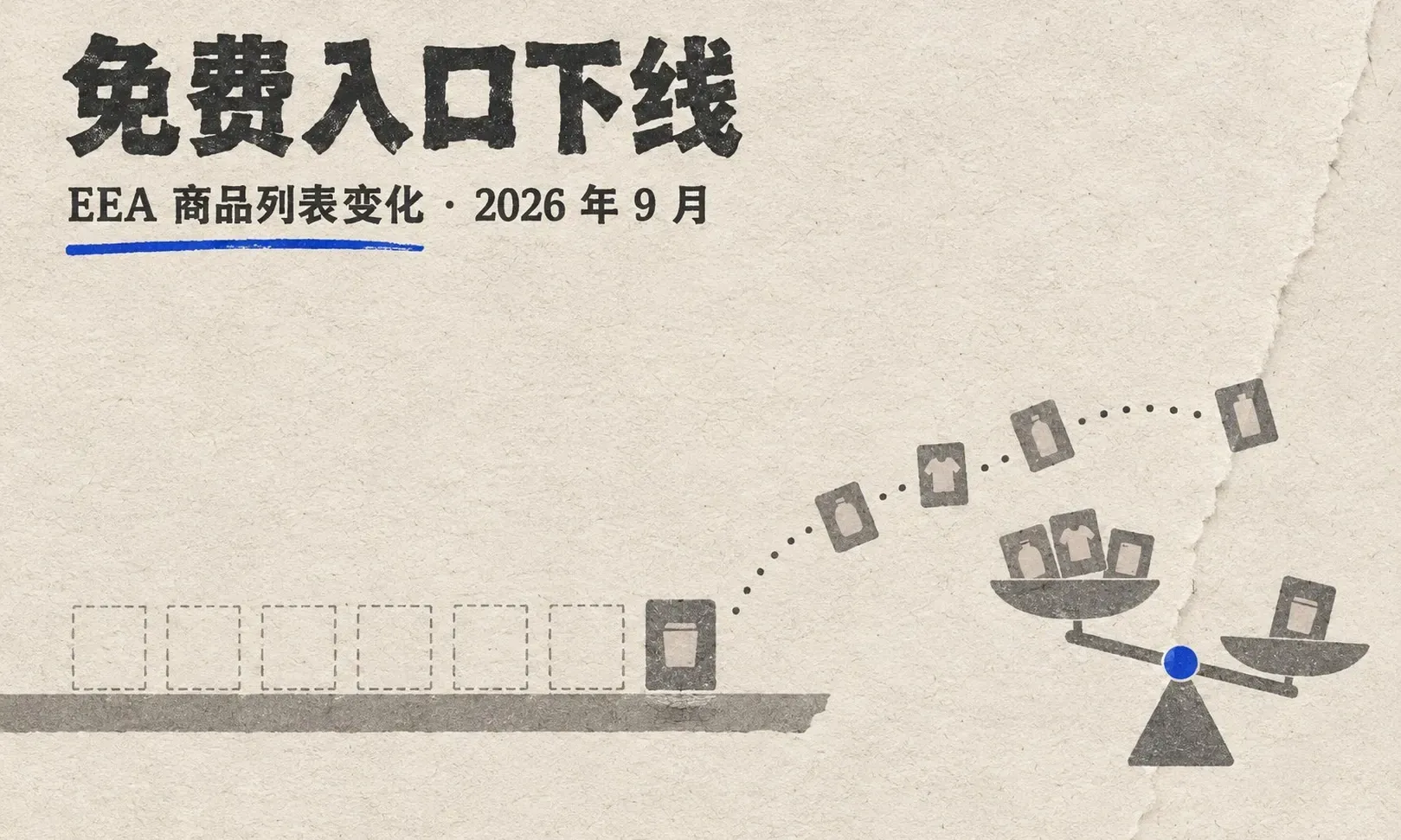
The change happened at the channel level. On September 18, Search Engine Roundtable reported that Google has taken free product listings and product carousels out of search results in the EEA (European Economic Area). Ginny Marvin, the Google Ads Liaison, confirmed the move in a comment, and the cause is a requirement the European Commission put forward under the Digital Markets Act (DMA). There is no need to unpack the DMA here. The one point worth keeping is that this is a structural change driven by regulation, not a routine product iteration.
For merchants, the verdict up front. What was removed is a free display entry in search, and it has nothing to do with the quality of your product data. The work now is to figure out which kind of change your European exposure saw, then to do the right set of actions.
Which entries are gone, and which remain
The scope covers free product listings and product carousels in EEA search, the organic product blocks that appear on commercial queries. Productrise, a third-party monitoring firm, published tracking data. In markets with sufficient data, including Germany, France, Belgium, Sweden and the Netherlands, product carousels have almost vanished from search results, and Semrush's public charts point in the same direction. Both sets of figures are third-party, with samples and methodology undisclosed, so treat them as directional only. The reading from industry observers is that the vacated space is going to comparison services, also called vertical search services (VSS). That is industry observation, not a Google statement.
In Google's own earlier public framing, this round of changes was described as the biggest reduction in its search quality ever, as relayed in Search Engine Roundtable's report. Setting the framing aside, one fact is confirmable. Google's search product presentation structure in the EEA has already changed.
Some things have not changed. Paid shopping ads and ordinary organic results are outside this round's scope, which touched the free layer. One more development from the same week. On September 8, Google published a set of regional feature documents that group the regional features for the EEA, Türkiye and South Africa, and two of those units appear only in the EEA. One is the aggregator unit, for vertical search services such as comparison sites; the other is the supplier unit, for brands and direct sellers. For product queries, the aggregator unit runs on the comparison shopping services track.
Sizing your own impact
Start by breaking your numbers apart. Do not use global averages. Pull the EEA market (the EU's 27 countries plus Iceland, Liechtenstein and Norway) out on its own.
Two data sources are enough. Market-level free performance data in Merchant Center, plus country and query-type impressions in Search Console, compared across 4 to 6 weeks before and after the change.
Then separate two kinds of decline. One is entry disappearance, where the whole block of impressions on product queries goes away together with the carousel slots, and the click mix shifts; the other is ranking decline, where impressions remain and positions slip. The first matches this structural change; the second is where conventional SEO work still applies. Mixing them up sends the effort in the wrong direction.
The scope stops at the EEA, which you can use as a control condition. Put non-EEA European markets such as the UK and Switzerland in the same table. If they hold steady while the EEA moves, that is strong evidence you are looking at this structural change.
Amplitude has to be self-measured. Third-party samples are limited, readings can differ widely across markets and categories, and another market's numbers should not be carried over as your own conclusion.
Four things worth doing now
First, get product data in order. This has the highest priority, because the new aggregator and supplier structures, paid shopping, and AI shopping assistants all run on the same product data. While you are at it, check the target-market settings in Merchant Center and make sure the products that should be live in EEA markets are live.
Google's official data requirements for aggregator participants work as a checklist, with complete entity information, clean images, specific categories, and prices and availability that match the landing page. Run your feed against it and fix what falls short.
Second, evaluate the comparison services path. Exposure for product queries now largely runs through the aggregator unit, and comparison services are its main players. If that path suits your category, it is worth understanding how to get your products into a comparison service's coverage and partnerships. The official documentation also defines a slot for brands. The supplier unit needs no extra feed, and a crawlable site is enough to be eligible, but it only appears alongside an aggregator unit that has already been triggered. Eligibility and process follow Google's official documentation, and product queries run on the CSS track.
Third, rebalance the paid side in Europe. With the free entry gone, the exposure mix in Europe has changed, and the budget split between shopping ads and PMax, along with structural tests, deserves a fresh pass on your own account data.
Fourth, write the regional difference into your planning. Treat the EEA and non-EEA as two separate markets from here on. Read the data separately, set next year's channel budgets separately, and stop making decisions from a single global report.
What not to do
Do not stop maintaining product data because the free entry disappeared. It is the easiest reaction and the most damaging one. Feed quality also determines your performance in paid campaigns, comparison services and AI shopping surfaces.
Do not treat it as a ranking problem. The entry itself was removed, so ranking optimisation has nothing to work on. Once you have confirmed entry disappearance, move your effort to structure and channels.
Do not present the shift to CSS as official. Google's documentation does not mention the DMA and does not explain the reason for the change. The direction is worth considering, and any citation should label it as industry observation.
Do not make budget decisions directly from third-party drop figures. Samples and methodology are undisclosed, so finish your own comparison window first, then decide what to move.
Related Reading
- PMax, Feed-only PMax, or Standard Shopping? A Testing Framework for Long-tail Product Visibility, the structural comparison method for shopping campaigns.
- The Google Ad Tech Remedy Ruling Is In: No Breakup, Behavioral Fixes and a Six-Year Monitor, and What Export Advertisers Need to Watch, the other regulatory track, for cross-reading.
- The Full Google Ads Playbook: From Strategy Design to ROI-Driven Optimization, a framework reference for rebalancing European campaigns.