
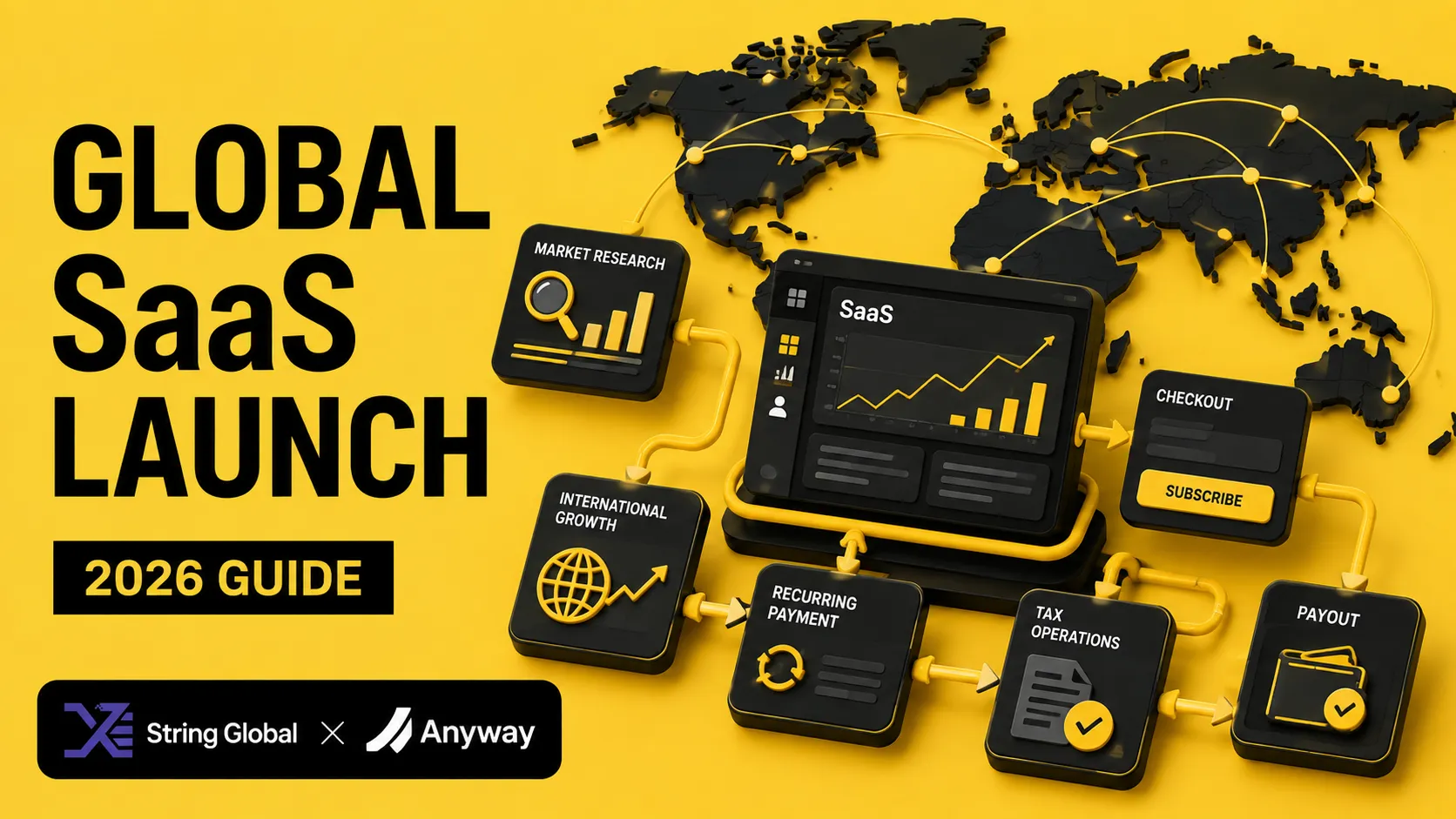
Launching globally means connecting two systems that founders often plan separately: customer acquisition and revenue operations. Pick one promising market, validate its buying problem, localize the offer, build a measurable acquisition path, and set up checkout, subscriptions, tax, invoices, and product access before sending serious traffic to the site.
The short version
To launch a SaaS product globally:
- Choose one beachhead market.
- Confirm the buyer, problem, and willingness to pay.
- Price from unit economics, not competitor screenshots.
- Localize the buying experience.
- Build one measurable acquisition path.
- Set up global subscription payments and tax operations.
- Launch a small paid test and review the full funnel.
The order matters. Buying traffic before the offer and payment flow are ready produces a dashboard full of clicks and very little useful evidence.
1. Choose one market before you translate anything
“Global” is a direction, not a launch market. A five-person SaaS team cannot learn North America, Western Europe, Southeast Asia, and the Middle East at the same time. Different buyers use different search terms, expect different proof, buy through different channels, and bring different payment constraints.
Start with a narrow hypothesis: one country or tightly related region, one ideal customer profile, and one urgent job. The String Global seven-day overseas market research framework organizes the decision around product, audience, and country. That is a better starting point than translating the homepage into six languages.
Score each candidate market on evidence you can check:
| Question | Evidence to collect | Warning sign |
|---|---|---|
| Is the problem active? | Search demand, community discussions, sales calls | Interest exists only in reports |
| Can you reach the buyer? | Search results, paid-media inventory, partner channels | No repeatable path to the decision-maker |
| Will the buyer pay? | Competitor pricing, interviews, paid pilot | Praise without a budget owner |
| Can you serve the market? | Language, support hours, product requirements | Localization cost erases the opportunity |
| Can you collect revenue? | Payment methods, currencies, tax treatment, payouts | Checkout or payout coverage is unclear |
The fifth row is easy to postpone. Don't. A market isn't commercially viable if qualified buyers reach checkout and cannot complete the purchase.
2. Decide whether the market is worth entering
Market size alone won't answer this. You need to know whether your team has a credible way to win and whether the resulting customers can support the cost of acquisition, service, and payment operations.
String Global's market-entry decision framework uses market attractiveness, ability to win, and commercial viability to reach a Go, Hold, or No-go decision. For a SaaS company, the commercial section should include at least these working numbers:
- expected monthly or annual contract value;
- gross margin after model, infrastructure, support, payment, and refund costs;
- maximum customer acquisition cost;
- expected time to recover that acquisition cost;
- likely conversion from qualified visit to paid account.
Imagine a $29 monthly product with a $70 acquisition cost. It looks workable if users stay for a year. It looks very different if the first cohort cancels after two months. A spreadsheet cannot predict retention, but it can show which assumption your launch must test first.
Use ranges instead of a single perfect forecast. A base case, weak case, and strong case reveal whether the plan survives ordinary variance. If the weak case puts every new customer underwater, reduce the initial acquisition budget and learn with a smaller sample.
3. Localize the buying decision, not just the copy
Translation fixes words. Localization fixes uncertainty.
A buyer needs to recognize the problem, understand the outcome, trust the proof, know the price, and complete payment. That means the localized offer may need different examples, landing-page order, currencies, billing intervals, support expectations, and proof. The product can remain the same while the buying argument changes.
Before launch, review four surfaces:
| Surface | What to localize |
|---|---|
| Landing page | Problem language, examples, proof, CTA |
| Pricing page | Currency display, billing interval, included usage |
| Checkout | Language, payment options, tax display, invoice fields |
| Lifecycle messages | Trial expiry, renewal, failed payment, cancellation |
Don't hide a payment surprise until the final screen. If tax may be added at checkout, say so. If the plan renews automatically, put the billing interval beside the price. If cancellation preserves access until the end of the paid period, make that state visible in the account.
This work improves conversion, but it also reduces support tickets. A clear purchase is easier to support than a clever one.
4. Build one acquisition path you can measure
The first campaign doesn't need to cover every channel. It needs to answer a commercial question.
For search-led demand, map keywords to buyer stages: problem education, solution evaluation, vendor comparison, and purchase. For paid media, use a small set of messages tied to the same landing-page promise. For AI search, publish pages with direct answers, clear product facts, FAQs, and sources that an answer engine can cite.
String Global treats research, web development, SEO/GEO, paid media, social, and demand generation as one connected growth system. Its AI search and GEO visibility service focuses on question coverage, answer accuracy, source coverage, and third-party authority. Those signals matter because a buyer may meet your category inside an AI answer before visiting a search results page.
Use one event chain across the funnel:
qualified visit → pricing view → checkout opened → payment completed → product activated → first value reached → renewal
If the chain stops at checkout opened, the acquisition message may be fine. The problem could be payment methods, unexpected tax, unclear billing terms, or a broken handoff. Without the events, all of those failures look like “low conversion.”
5. Set up global subscription payments for SaaS
Global subscription payments for SaaS require more than card processing. You need recurring billing, tax calculation and filing, compliant invoices, refund handling, payment recovery, payout operations, and a dependable way to tell the product which customer has paid.
There are two common operating models:
| Responsibility | Payment processor | Merchant of Record |
|---|---|---|
| Checkout and payment processing | Provider processes payment | MoR operates the covered transaction |
| Seller shown on the transaction | Your company | MoR |
| Sales tax, VAT, and GST | Usually your responsibility | MoR handles covered obligations |
| Customer invoices | Your system or another tool | Included in the MoR transaction flow |
| Refund and transaction administration | Split across your systems | Managed under the MoR service scope |
A processor can be the right choice when your company already has tax registration, invoicing, finance, and compliance operations in place. A Merchant of Record for SaaS is useful when the team wants one provider to take the seller role for covered transactions and handle the attached payment administration.
Anyway provides hosted payment links, one-time and recurring billing, tax calculation and filing, invoices, and payouts as a Merchant of Record. The payment link can sit behind a pricing-page CTA, inside the product, or in a sales conversation. That makes it possible to test a market without first building a custom checkout stack.
Read the provider's eligibility, verification, product, country, and payout rules before committing. “Global” never means every product in every jurisdiction with no conditions.
6. Connect payment status to product access
A successful redirect is not proof of payment. Browsers close, users refresh pages, and redirect URLs can be replayed. Treat the server-side payment event as the source of truth.
Define the subscription states before writing the handler:
| Event | Billing record | Product action |
|---|---|---|
| First payment succeeds | Mark subscription active | Grant the purchased plan |
| Renewal succeeds | Extend paid-through date | Keep access active |
| Payment fails | Record failure and retry state | Apply the documented grace policy |
| Subscription cancels | Store effective cancellation date | Keep or remove access as promised |
| Refund completes | Record refunded amount | Revoke or adjust access under policy |
Use signed payment webhooks, verify the product and amount against your own records, and store the delivery ID. Webhooks may be retried. Processing the same event twice must not grant two subscriptions or two blocks of credits.
One more detail: never place email addresses, API keys, or sensitive customer data in a checkout URL. Use an opaque internal user or purchase ID, then resolve it on your server.
7. Launch small and review the whole commercial loop
Your first paid launch is an instrumented experiment. Give it a budget cap, a fixed market, one offer, and a review date. Changing five variables midway destroys the lesson.
Track more than cost per click:
- qualified visits by source;
- pricing-page engagement;
- checkout starts and completions;
- activation and first-value completion;
- refunds, failed renewals, and early churn;
- gross margin after serving the account.
Suppose ads produce 100 qualified visits, 12 checkout starts, four payments, and one activated user. The checkout completion rate may look healthy. The product handoff is the leak. Buying more traffic simply buys more people who get stuck after payment.
This is where demand generation and revenue operations have to share one report. Marketing owns the promise that brings the buyer in. Product and payments determine whether that promise turns into retained revenue.
Common global SaaS launch mistakes
Launching several countries as one market
The campaign may report an acceptable blended acquisition cost while one country generates nearly all the qualified customers. Segment results from day one.
Copying a competitor's price
Their infrastructure cost, support load, tax setup, and target customer may be different. Use competitor pricing as evidence of buyer expectations, then build your own margin model.
Treating payment as a final-week task
Payment affects the pricing page, tax display, invoices, refunds, entitlement logic, and analytics. Test it with the product, not after the product.
Activating accounts from the success page
Use verified server-side events. The thank-you page is useful for the buyer; it is not an accounting record.
Frequently Asked Questions
What are global subscription payments for SaaS?
They are recurring payments collected from customers across multiple countries, usually with support for different currencies, tax treatment, invoices, renewals, cancellations, and payouts. The difficult part is maintaining the full subscription lifecycle, not displaying a card form.
Do I need a Merchant of Record to sell SaaS globally?
No. A company can combine a payment processor with its own tax, invoicing, compliance, refund, and finance operations. A Merchant of Record is attractive when the company wants a provider to take responsibility for the covered transaction and its associated administration.
Can I launch before opening a local company in every market?
Often, yes. You still need an eligible legal or individual setup accepted by your providers, and you must complete identity and business verification. You normally do not need to incorporate separately in every customer country just to test demand. Confirm the current rules for your product and location before selling.
Which market should a SaaS company enter first?
Choose the market where buyer pain, reachable demand, your ability to serve customers, and commercial viability overlap. A large market with expensive acquisition and weak payment access may be worse than a smaller market where you can learn quickly.
When should I localize pricing?
Localize pricing when currency, purchasing power, procurement practice, or payment expectations materially affect conversion. Don't create regional prices until you can explain the rule, prevent obvious abuse, and measure margin by market.
Put the launch in the right order
The clean sequence is research, commercial model, localized offer, acquisition, payment, product access, and review. Each step creates evidence for the next one.
Use String Global to plan and execute the overseas growth path. Use the Anyway Business Quickstart to create a product, publish a payment link, verify the buyer experience, and prepare payouts.
Then launch to one real market. “Worldwide” can wait until the first loop works.