


Introduction
Global marketing for sex toys is a high-demand, high-repeat-purchase category, but it also comes with a high review threshold. Compared with ordinary consumer goods, adult product brands going overseas must solve not only acquisition cost, conversion rate, and repeat purchase, but also platform policy, cultural differences, payment compliance, ad review, and creative limits. On platforms such as Google, X, Pornhub, and Meta, the way these products are defined is not consistent. If a brand uses the same creative, landing page, and copy across all platforms, ads can be rejected, accounts can be restricted, and media assets can even be suspended.
This article looks at overseas user preferences, localization strategy, mainstream platform review standards, and platform recommendations to help sex toy brands build a more stable global marketing plan.
1. The Core of Global Sex Toy Marketing
In mature overseas markets, sex toys have gradually moved beyond the narrow traditional perception of adult products. More brands now position the category as sexual wellness, intimacy care, self-care, or couples wellness, which is easier for mainstream consumers, media, and platforms to accept. When overseas consumers choose this type of product, they often pay close attention to privacy, safety, design, and brand tone. For example, they may care about discreet shipping, unbranded packaging, billing privacy, body-safe and easy-to-clean materials, and whether the product looks clean and modern rather than vulgar.
At the same time, overseas markets are more sensitive to brand values and content expression. Strong brands usually respect different genders, relationship models, body types, and LGBTQ+ users, and avoid overly heteronormative or narrow aesthetic narratives. Instead of directly emphasizing stimulation or enhanced pleasure, it is usually better to build trust through angles such as relationship improvement, sexual health education, body awareness, self-care, and partner communication. This helps create a more professional and sustainable brand image.
2. Preferences Across Race and Ethnicity
Many brands going global wonder whether different racial or ethnic groups have different preferences for sex toys, but this question needs to be handled very carefully in marketing and advertising. Brands should not simply assume what white, Black, or Asian users like and use that as the basis for product demand or ad targeting. Ethnicity is not the only factor that shapes consumer behavior. Age, religion, education level, urbanization, income level, relationship status, and openness toward sexuality often have a stronger impact on purchase behavior. At the same time, major overseas advertising platforms are highly sensitive to personal attributes such as race and ethnicity. For example, Meta prohibits ads from directly or indirectly implying a user's race, ethnicity, sexual orientation, or sexual practices.
For sex toy brands, stereotyped, exoticized, or label-based expression can create compliance risk and damage the brand's sense of safety, respect, and inclusion. A more compliant and more sustainable approach is to localize by region, culture, language, use scenario, and privacy needs. For example, brands can adjust product expression, ad creative, and educational content according to each market's level of cultural openness, platform rules, communication habits, privacy expectations around delivery, and content acceptance. Below are several market research observations:

1. North America: privacy, inclusion, and self-care
Users in the United States and Canada are relatively receptive to sexual wellness, and they are also more sensitive to privacy, material safety, and brand values. Content can emphasize directions such as discreet delivery, body-safe material, inclusive design, solo care, and couples intimacy.
2. Western Europe: safety standards, aesthetics, and sustainability
Consumers in the United Kingdom, Germany, France, and the Nordic countries pay closer attention to product materials, eco-friendly packaging, warranty, and brand professionalism. The design language should be more premium, minimal, and lifestyle-oriented.
3. Latin America: strong interest, but relatively conservative public expression
Latin American users are relatively receptive to content around intimate relationships and couple interaction, but some markets still have strong family and religious cultural influences. Ad creative can lean more toward romance, partner relationships, and private gifting rather than intense stimulation.
4. East Asia: low-profile, refined, quiet, and easy to store
Markets such as Japan, South Korea, and Taiwan are sensitive to exterior design, low noise, portability, and packaging privacy. Visuals can borrow from technology, beauty, and lifestyle categories, while reducing overly explicit expression.
5. Parts of the Middle East and South Asia: high compliance risk
Some countries and regions have strict restrictions on adult products, adult content, import sales, and advertising. Before entering, brands must confirm local laws, payment rules, logistics requirements, and advertising policies instead of looking only at traffic cost.
In short, global marketing should take cultural differences seriously, but it should not divide markets only by race. Brands need to test real market feedback through local language, local aesthetics, and local compliance rules.
3. Review Standard Differences Across Google, X, Pornhub, and Meta
1. Google
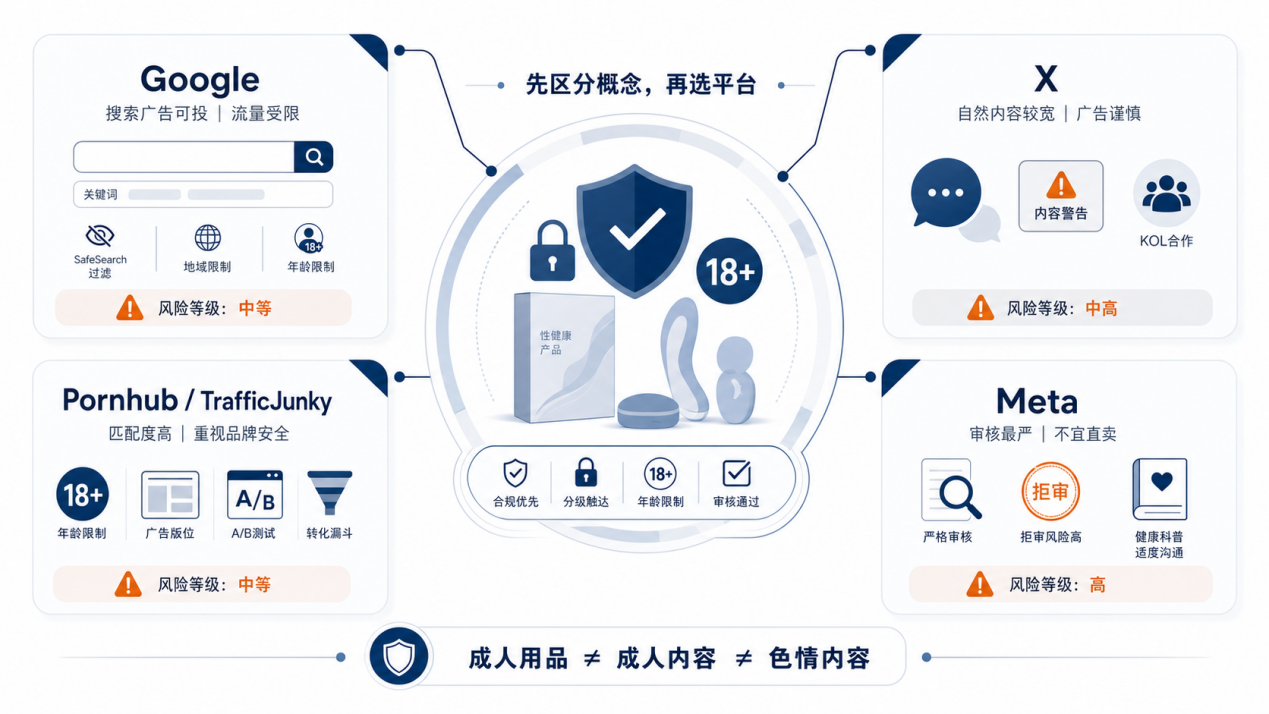
Google Ads does not completely ban sex toys or sexual health products. Instead, it classifies them under different policies. Most sex toys fall under the Sexual content policy. Whether an ad can be shown depends on product category, ad creative, user age, local law, user search intent, and other factors, not simply on the product itself.
For example, sex toys, sexual enhancers, fetish lingerie, and similar products are usually classified as sexual merchandise and treated as restricted content. These ads are not necessarily completely banned, but they are usually eligible to show only in limited contexts. They cannot be targeted to minors and must comply with the laws and regulations of the target country. For sex toy brands, Google Ads is therefore more suitable for capturing brand terms, product terms, and high-intent search traffic than for relying on Display, YouTube, or other broad traffic channels to scale quickly.
For some sexual health products such as lubricants, Google has a separate Sexual health and wellness policy. Under the conditions of approved countries, 18+ targeting, and medical policy compliance, some products can be advertised. However, ads must not use sexual pleasure or sexual enhancement as the core selling point, and they should not use obviously suggestive creative. Instead, messaging should focus on healthier and more neutral expressions such as sexual wellness, personal care, body-safe, and relationship wellness.
In addition, even if an ad is approved, that does not mean it will receive full traffic. Google treats sexual content as a sensitive category and applies additional restrictions to personalized ads and audience targeting. Brands should therefore expect weaker reach and fewer targeting options than they would have for ordinary consumer goods. For sex toy brands, a more reasonable strategy is usually to use Search Ads to capture high-intent users, while using SEO, brand content, and community operations to build long-term traffic, instead of depending on large-scale display advertising for fast volume.
2. X
X has a relatively broad content tolerance, but paid ads still need to be handled carefully according to the Adult Content policy. At the content level, X allows adult nudity or sexual behavior content that is voluntarily created and distributed by adults, but it must be correctly labeled and cannot appear in highly visible places such as avatars, banners, or live video. Users under 18 also cannot view marked adult content. At the advertising level, X is much stricter about adult sexual content, and advertisers need to reference both the Adult or Sexual Products and Services policy and the Brand Safety Policy. The platform explicitly prohibits promotion of adult video or pornographic content. Only some sexual education, artistic nudity, medical illustrations, erotic literature, and certain contraception or lubrication-related content are allowed in limited countries. As a result, X is better suited as a content distribution channel than as the core advertising platform for adult-related brands.
3. Pornhub
Pornhub is the best match for adult products by category, but brands still need to pay serious attention to brand safety and creative testing. Pornhub itself is an adult content platform, but that does not mean review is loose. Based on its public transparency documents, the platform emphasizes that only verified creators can upload, and content is manually reviewed before publication. For minor-related content and non-consensual content, the platform takes a zero-tolerance approach, including removal, content fingerprinting to prevent re-uploads, and account bans. Uploaders are also required to keep performer consent files and age or identity verification materials. In short, Pornhub's focus is not on restricting adult content itself, but on strengthening uploader qualifications, proof of consent, and accountability for violations.
4. Meta
Within the Meta ecosystem, public content and recommendation traffic related to nudity and sexual content are among the strictest. Violations may not only lead to post removal, but also reduced recommendation. Instagram's official Community Guidelines clearly prohibit depictions of sexual intercourse, genitals, and close-ups of fully nude buttocks. Some female nipple content is also not allowed, though exceptions are retained for breastfeeding, childbirth, medical health, protest, and art.
More importantly, Meta's Recommendations Guidelines are stricter than the Community Guidelines. Even if content is not deleted, if it is considered sexually suggestive or related to adult products or services, it may still be excluded from recommendation surfaces such as Explore, Reels, and Suggested For You. The biggest challenge for adult and sex toy brands on Meta is not only whether content can be posted, but whether it can be distributed. If a brand chooses the Meta ecosystem, it needs sufficient preparation and a complete compliance plan.
4. Platform Recommendations: How Should Sex Toy Brands Allocate Global Channels?
First priority: Google Search + SEO
Google Search and SEO are better suited to sex toy brands that already have an independent site, compliant products, and the ability to produce English content and build a keyword strategy. These channels have the advantage of clear user search intent and relatively high conversion quality, making them suitable for users who already have active purchase or research needs. Brands can use Google Ads to acquire short-term high-intent traffic while building an SEO blog to accumulate long-term organic traffic. Example topics include "How to choose body-safe sex toys," "Best discreet vibrators for beginners," "Silicone vs TPE: which is safer," "How to clean adult toys," and "Couple intimacy tips." Overall, Google Ads is better for short-term precise acquisition, while SEO helps improve long-term brand visibility, user trust, and organic traffic accumulation.
Second priority: Pornhub, TrafficJunky, ExoClick, and TrafficStars
These adult traffic platforms are better suited to brands that want to quickly test market response, have clear average order value, and already have a relatively complete conversion funnel. They are especially suitable for direct sales of adult products. During campaign execution, brands need to pay close attention to creative testing and data attribution. By continuously comparing different ad creatives, audience directions, and landing page performance, brands can identify which combinations produce real conversions instead of only clicks.
Specific testing dimensions can include country, device, placement, audience, and landing page. For countries, brands can test markets such as the US, UK, CA, AU, DE, FR, and ES, then compare results based on market size, regulation, language environment, and conversion performance. For devices, brands can separate Mobile and Desktop. Mobile traffic is usually larger, while desktop may produce higher average order value. For placements, brands can test Native, Banner, Interstitial, and Video formats and observe differences in CTR, conversion rate, and cost. For audiences, brands can split by couples-oriented, female-oriented, male-oriented, and LGBTQ+ friendly directions. For landing pages, brands can test product pages, collection pages, review pages, and discount pages to understand how page type affects conversion rate and average order value.
Third priority: X organic content + creator partnerships
X is better suited to topic distribution and interaction with adult-friendly communities. It is especially useful for sex toy brands doing brand exposure, user communication, and creator partnerships, rather than relying only on hard-sell ads for conversion. Brands can use creator content to build credibility and authenticity. For example, they can partner with sex education creators, adult industry KOLs, LGBTQ+ creators, intimacy and relationship consultants, and adult content creators, using their content style and community influence to reach more precise users. During collaboration, however, brands must make sure the content is legal and compliant, all people involved in the partner or creative materials have completed age verification, and all KOL or UGC content has clear authorization. Brands should avoid minors, non-consensual content, infringing materials, and platform policy violations.
Fourth priority: Meta for brand education, not direct conversion
Meta is not recommended as a direct sales advertising channel for sex toys, because the platform is sensitive to adult products, sexual suggestion, and personal attributes. Direct promotion of adult toys can easily trigger review or delivery risks. But if the brand is positioned as sexual wellness, it can use a softer and more educational approach for brand building and upper-funnel operations. Examples include blog traffic, brand stories, women's health content, partner communication content, newsletter subscriptions, and retargeting asset building with non-explicit creative. The core principle is that on Meta, brands should focus on health, relationships, and education rather than directly selling pleasure or adult toys.
5. Compliance Suggestions for Global Sex Toy Marketing
Adult product ads and landing pages must put compliance, safety, and privacy at the center of global marketing. All ads and pages should set age thresholds where appropriate and avoid reaching minors. Copy should not directly or indirectly imply a user's race, sexual orientation, or sexual practices, and should avoid language such as "designed for a certain ethnicity" or "are you a certain sexual orientation." Different platforms should use different landing page versions. Google pages should lean more toward health and product information, Meta pages should lean more toward education and brand expression, and adult traffic platform pages can be relatively more direct. Brands should avoid using the exact same page across all platforms. Creative should also be managed by level, such as SFW, Mild, and Adult, to match each platform's rules. At the same time, brands need to highlight privacy promises that overseas users care about, such as discreet shipping, secure payment, and plain packaging. They should avoid exaggerated medical, psychological, or physical effect claims that cannot be proven, and ensure that KOL and UGC creator content is authorized and does not involve minors, non-consensual content, deepfakes, or infringing assets.
Conclusion
The key to taking sex toys global is making the brand more trustworthy, safer, and more localized. Different platforms play different roles. Google Search and SEO are suitable for long-term high-quality acquisition. Pornhub, TrafficJunky, ExoClick, and TrafficStars are suitable for adult traffic conversion testing. X is suitable for community and creator distribution. Meta is more suitable for brand education and upper-funnel development, not direct sales of sex toys.
Ultimately, brands should run localized tests based on regional culture, language environment, consumption scenarios, and real data. In short, adult product brands that can grow over the long term do not rely on suggestive shortcuts or misleading tactics. They rely on trust built through product safety, privacy protection, content education, and compliant operations.