



On July 9, 2026, Google updated its advertising policies and began rolling out a new "AI content label" setting across five products: Google Ads, Display & Video 360, Campaign Manager 360, Merchant Center, and Ads Editor. Advertisers can now mark an individual image or video asset as "created or edited with AI."
On the surface, this is one more checkbox.
In practice, what this update really changes is where liability sits. Google built the rails for disclosure, wrote the documentation, and then stated plainly in that same documentation: using this setting does not guarantee compliance with any specific regulation, and you should seek your own legal advice to confirm that your ads and assets meet local obligations. On July 13, Google further clarified that publishers carry no labeling obligation.
The rails belong to Google. The steering wheel and the fines belong to the advertiser.
The mandate isn't coming from Google. It's coming from three jurisdictions.
Here is the point that a great deal of coverage gets wrong: Google has not issued a platform-wide ban requiring every ad using AI assets to be labeled globally. What it has done is provide the tooling, and enforce it automatically in the regions where the law requires it to.
The enforcement comes from three separate laws that do not use the same definitions.
The EU: AI Act Article 50, applicable from August 2
The EU AI Act's transparency obligations apply from August 2, 2026 — this month. The law splits responsibility into two layers. Providers must ensure that audio, image, video, and text output by generative systems carries machine-readable markings that can be detected as artificially generated or manipulated. Deployers — that is, you, the party using the tool to make ads — must disclose deepfake content in a clear and distinguishable manner at the point of first exposure to the audience.
There is one line in the European Commission's official FAQ that international teams should read more than once: deployers cannot rely solely on the machine-readable markings embedded by providers to satisfy their disclosure obligation. Disclosure must be perceivable and understandable to a natural person without any technical tools — a visible label or an audible cue, for example.
In other words, the fact that your AI tool buried C2PA metadata in the file does not make you compliant. The user has to be able to see it.
Penalties run up to €15 million or 3% of global annual turnover, whichever is higher. For systems placed on the market before August 2, 2026, the marking and detection obligations have a grace period running to December 2, 2026.
On June 10, 2026, the European Commission published the Code of Practice on Transparency of AI-generated Content, organized into a provider section and a deployer section. Signing is voluntary, but Article 50 itself is a hard legal obligation. As of July 31, 2026, roughly 190 organizations had signed.
India: SGI labeling, already in force since February
India's Ministry of Electronics and Information Technology (MeitY) published amendments to the Information Technology (Intermediary Guidelines and Digital Media Ethics Code) Rules on February 10, 2026, introducing the concept of "Synthetically Generated Information" (SGI), effective from February 2026.
SGI covers audio, visual, or audiovisual content that has been computationally created or modified so that it appears authentic or is difficult to distinguish from real people and real events. Platforms are required to compel users to declare whether content is synthetically generated before publishing it; to label published SGI prominently and visibly; and to embed tamper-proof metadata or unique identifiers that make source, provenance, and modification history traceable.
India's approach leans harder than the EU's toward platforms demanding declarations from upstream. That means the questions you get asked when advertising in India will be more direct, and they will come earlier.
New York: synthetic performers, effective June 9
New York Senate Bill S.8420-A / Assembly Bill A.8887-B was signed by Governor Hochul on December 11, 2025 (Chapter 617), taking effect on the 180th day after becoming law — June 9, 2026. It amends Section 396-b of the General Business Law.
The requirement: any advertisement that includes a "synthetic performer" must conspicuously disclose that fact. A synthetic performer is defined as a digital asset created, replicated, or modified by computer, using generative AI or a software algorithm, intended to give the impression that the asset is delivering a visual or audiovisual performance that would otherwise be performed by a human, and that is not recognizable as any specific, identifiable real natural person.
Penalties: $1,000 for a first violation, $5,000 for each subsequent violation.
Exemptions include audio-only advertising; the use of generative AI solely for language translation; and promotional material for entertainment works such as films and games, where the use of a synthetic performer is consistent with the work itself.
One asset-level toggle, two very different layers of disclosure
Three technical details in Google's implementation directly shape how you should operate.
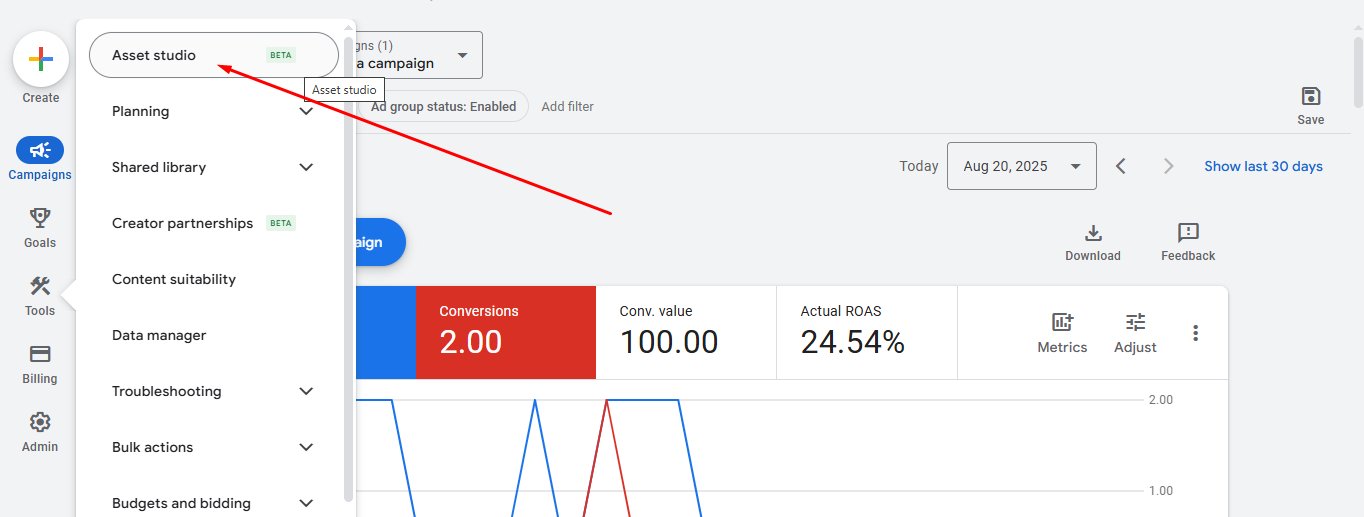
First, the label is asset-level, not campaign-level. You set it asset by asset in the Asset Studio library, or you handle it via prompts when creating a campaign or generating assets with AI. When the system determines that your assets may require labeling, it surfaces a "Review assets" prompt listing the unlabeled assets in a table. You work through them one at a time, choosing either "Label this asset as created or edited with AI" or "Don't label this asset."
Second, disclosure has two layers, and their visibility is worlds apart. The global layer is the "How this ad was made" section in the My Ad Center panel — users have to click the three-dot menu on a Search, YouTube, or Discover ad to see it, and the overwhelming majority never will. The regional layer is where disclosure actually becomes visible: for campaigns targeting the EU, India, and New York, labeled assets display a visible overlay label directly on the ad.
This is also why Google notes that labels added under this policy do not constitute a violation of its policies restricting text overlays. It has carved out an exception for its own label.
Third, Google will apply labels automatically, and you cannot override them. Google labels assets on its own in three situations: when it is legally required to do so in a given region; when it receives signals from other platforms indicating AI involvement; and when you use Google's fully automated creative generation features. These automatic labels cannot be overridden by the advertiser.
That last point deserves separate thought if your accounts lean heavily on Performance Max and Google's native generative asset tools: your assets may already carry an AI label that you never declared and cannot remove.
New York's law is the one cross-border companies are most likely to trip over
Most international teams have at least heard of the EU and India rules. The real blind spot is New York.
There are three reasons.
It's determined by audience, not by place of incorporation. If an ad reaches New York consumers, it falls within scope — whether the advertiser is registered in Shenzhen, Singapore, or Delaware. And the vast majority of Google Ads accounts targeting North America include New York State in their default geographic targeting.
It governs digital humans, not "AI images." A lot of teams self-assess along the lines of "we don't do deepfakes, no real people are involved." New York's law works the other way around — it specifically governs synthetic figures that do not point to any identifiable real person. Use AI to generate a model who doesn't exist to showcase a product, produce a talking-head video with a digital human, run a YouTube ad with a virtual presenter: all of it is in scope. This kind of asset is already standard practice in cross-border e-commerce, DTC storefronts, and consumer electronics categories.
It pulls agencies in as well. The law points at the parties that "produce or create" the advertisement, which covers both the advertiser and its agency. If you outsource asset production and your contract has no AI-usage declaration clause, outsourcing does not transfer the risk.
Per-violation penalties of $1,000 and $5,000 look modest. But these are civil penalties assessed per violation, and your exposure equals every ad containing a digital human that you have ever served into New York.
Self-declaration and documentation belong inside your campaign workflow
Compliance is not a one-time check before launch. It's a record chain that runs across the asset lifecycle. For international teams, the minimum viable loop has four steps.
Build an asset ledger
For every image and video asset that enters a campaign, record four fields: generation tool (Google native / Midjourney / Runway / third-party agency output), degree of AI involvement (fully generated / partially edited / color and crop only), whether it contains a human figure, and whether it contains an identifiable real person. The first two fields determine your EU position, the third determines your New York position, and the fourth determines deepfake risk.
The value of this ledger isn't at launch. It's when someone asks. The EU's deployer obligation, India's platform-level declaration requirement, and New York's evidentiary burden all require you to be able to answer the question "where did this asset come from?" Without a ledger, you can't.
Split campaigns by region
If your North American campaigns cover New York alongside other states and your assets include digital humans, the cleanest approach is to break out the three jurisdictions — EU, India, New York — into separate campaigns. Two benefits: the visible overlay label affects asset presentation only for that slice of traffic, which makes it possible to test its impact on CTR in isolation; and geographic targeting changes leave a traceable operational record.
The cost is a more complex account structure and fragmented learning periods. That tradeoff depends on New York's share of your North American volume. When the share is very low, simply excluding New York State is a pragmatic option.
Put declarations in your agency contracts
Teams that outsource asset production need a clause in the contract or SOW: the supplier must declare in writing the AI usage behind every delivered asset, including whether generative AI was used and whether the asset contains a synthetic human figure. New York's law makes agencies liable parties, but that does not make advertisers exempt — it means both sides need to be able to substantiate their position.
Label proactively instead of waiting for Google to do it for you
Since Google's automatic labels can't be overridden, declaring proactively is the more controllable option. If you label the assets yourself, you at least know which ones are labeled, where the label appears, and which traffic it affects — enough to plan A/B tests around it. If you wait for the system to label them, you'll only find out when your reporting looks strange.
A tooling boom and a disclosure crackdown landed in the same quarter
The timing is worth noting.
According to public tracking, more than 60 AI products launched in July 2026 alone, among them Anthropic's Claude Sonnet 5, OpenAI's GPT-5.6 family (the Sol / Terra / Luna tiers), and Google's Gemini Flash line, Gemini Spark, and Google Vids.
Google Vids in particular should have marketing teams paying attention — it offers video generation and personalized avatars. That is precisely what New York's synthetic performer definition was written to capture.
The result is a pincer. The marginal cost of asset production fell off a cliff in a single quarter, taking AI video, digital-human voiceover, and virtual models from "needs budget and a production schedule" to "a few clicks." In that same quarter, the compliance cost of those assets was priced by three laws simultaneously for the first time.
Marketing teams have historically evaluated AI assets on throughput and CPA. Starting this quarter, there's another dimension to add: if we were asked to account for where this asset came from, could we answer?
Teams that can account for their asset provenance can safely enjoy the efficiency gains from AI. Teams that can't: the more AI assets you produce, the more you will have to explain later — every asset with unclear provenance is a potential compliance risk.